Wednesday, October 15, 2014

Hi-Yo Silver! Get 'Em Up Scout!

Me write 'em novel. You vote me best. Me sell soul to Amazon
Crowdsourcing Platform just didn't have the ring that Amazon needed for its new crowdsourcing platform.

From this day forward, writers---Get 'em up, Scout!

The initial buzz has become a reality and Amazon is now providing information on a new strategy to get itself into publishing. You might think that Amazon is a bit behind the times, given the considerable decline in popularity of the popularity contests that made Simon Cowell wealthy. For a time, it was thought to be a good way to assess talent, by having people perform and then letting the audience choose their favorite. If the public had what they wanted, the reasoning went, surely they would then buy what the talent produced.

As things turned out, the public did not support what they elected. Winners of past televised competitions could fill an entire "Where Are They Now?" programme.

But Amazon is not deterred. Their new addition will take that popularity contest and apply it to the written word. It will be called Kindle Scout.

No one is going to spend money on printing books that may not sell. An e-book is the most economical means to test the system and see if a popularity contest can result in a best-seller.

The author has to come up with the costly items, like a book cover and back copy that will intrigue and captivate readers. The author has to do the spell-checking and the editing, or pay an editor to do it. The writer has to create a logline and a short synopsis, which means the author has to have some powerful marketing skills. An extremely talented writer without those skills will lose the contest even though their novel is far superior. That's why authors want literary agents to represent them to the Big Five publishing houses. So if marketing isn't your thing, there's another expense for you.

Did no one at Amazon notice that their Breakthrough Novel Award hasn't produced any blockbuster best-sellers yet? But still the mighty behemoth pushes ahead, to do the same thing with digital books.

As was already described, the Scout scheme has an author competing against fellow authors to make the cut. They then have to convince their friends and friends of friends ad infinitum to choose their novel as the best of the bunch. The winner than gets to have their book published by Amazon Kindle, which you could do for free without going through the work of the selection process but everyone loves a competition.

The winner then sells their soul to Amazon in the form of a five year deal in which Amazon holds the rights. Again, you could keep the rights yourself if you just went and published the book yourself, but there's a temptation tossed in. Amazon will give the winner an advance of $1500. Sell more books than are covered by the advance on royalties and you'll be raking in the money.  That will be a lot of e-books.

What an author gains is what publicity Amazon will deliver to promote the contest and make it appealing to more authors who in turn bring in more of the public to Amazon's digital world. All it takes is one best-seller to get things going for Amazon, which has not shown any sort of success in its publishing ventures.

So get 'em Scout!

Tuesday, October 14, 2014

Public Works Used To Be Heavy-Duty

Old school
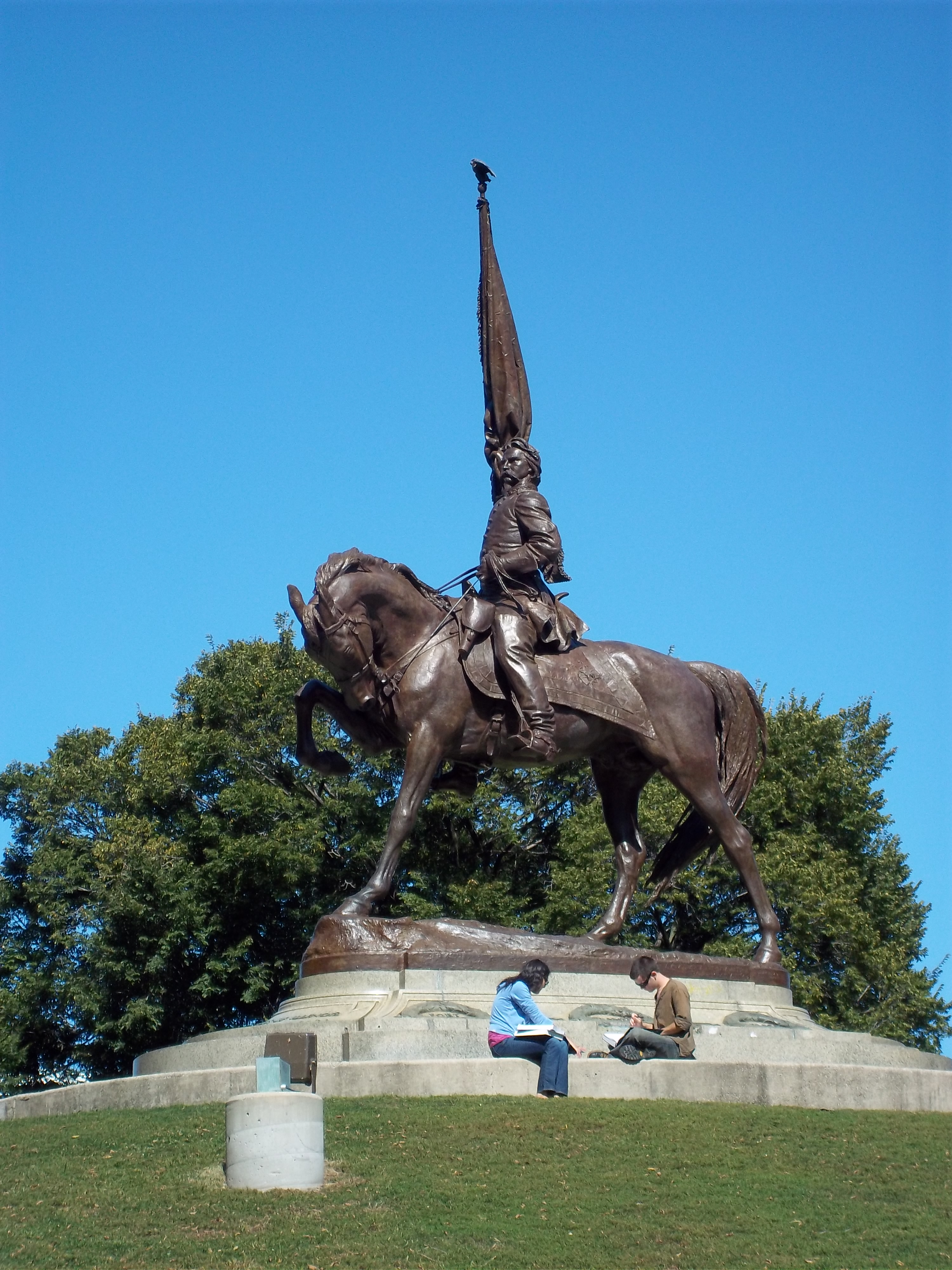
Think back to the Days of Rage, when Chicago was hosting the Democratic National Convention and the war protest movement arrived to, well, protest. Some of the unwashed masses climbed the statue of Civil War general John Logan and did their protesting from an elevation. The statue didn't break, did it?

Of course not. Because back in the day, civic leaders ordered memorial statues that were built to last. The statue is still there, in fact, still standing proud and tall in Grant Park.

The new trend these days is to slap up a monument that isn't going to be permanent. Change them out every year or two, and then advertise like crazy to get the tourists in to see the new series of memorials. The statues aren't intended to last forever because tourists don't come back to see the same painted cows or furniture or even a giant Marilyn Monroe.

There is a slight problem with these temporary installations.

Tourists take pictures with them, in part to memorialize a trip to Chicago and in part to preserve an image of an object that's going to be taken off the street in a short period of time.

And when tourists take pictures, there's no security guard there to yell at them when they decide to pose themselves on the statue.

Not exactly Days of Rage posing, but isn't it cute to put little Junior on the back of that colorful horse statue that commemorates one of Chicago's fallen police officers?

Modern throw-away culture
And isn't it funny to mount up when you're drunk and have your friends snap your photo while you do your impression of the 1968 protesters climbing all over John Logan's horse?

When that equine objet d'art is made of fiberglass, you can bet that at some point things are going to get broken. And that is exactly what is
happening to Chicago's horses on parade.

A horse decorated to look like Pegasus lost its wings when a man at the age of foolishness (twenty-something is a dangerous time for the developing male brain) climbed up and sat on the horse. The wings, unfortunately, were right where a rider's legs would be, and, well, this isn't a bronze replica of a horse. The wings broke off and Darius Moss is looking at three felony counts of criminal damage to property. News reports don't say, but we all can assume the man was under the influence of intoxicating beverages at the time. Or he just thought it would be funny. Not that he's laughing now.

Then there was the horse that the cast of "Chicago PD" was good enough to sign. At the conclusion of the exhibit, the horses are going to be auctioned off for a charity benefitting the families of fallen police officers, and that horse was likely to bring in some big money. Someone saw all those signatures and thought the art would be improved with graffiti. Somewhere there's a cell phone with a picture of the art and the artist, If the photo finds its way to the police department, there'll be a second individual looking at a felony count or two.

There's the horse-tipping incident that resulted in some serious injury, to the statue. A family was doing what they were supposed to be doing, but who knew there was a load limit on the statue? Did the John Logan statue buckle under the weight of the hippies? No. But the horse statue went right over. What's next? Some prankster will find inspiration and decide to reproduce the horse head scene from THE GODFATHER, but with fiberglass. Halloween is coming. What could be more fun at the end of a night of binge drinking?

They don't make art like they used to. Nothing is made to last.

Monday, October 13, 2014

Clever Word Play Is Not Always Appropriate

Alex Lyons is not the first person to have problems with Ireland's health service. The man was so unfortunate as to fall ill in the first place, and then found himself in a tangle of bureaucracy that left him so frustrated he lashed out. It was the lashing out with his tongue that got him in trouble.

Mr. Lyons is a comedian who has written for radio artists. You may have heard some of his cleverly scripted banter on the radio, but you'd never know it of course because there are no credits rolling at the end of a radio programme.

The gardai who were given a performance at St. James Hospital had no idea they were dealing with a man who had a particular affinity for the spoken word. They clearly did not get the joke. Mr. Lyons got arrested.

The comedian-writer was upset at being discharged from hospital following treatment for a stroke, not because he was not properly treated, but because he was not properly sent off with the required paperwork that he needed to get financial assistance to tide him over until he was fully back on his feet and able to compose humorous sentences once again.

When you're not well, you don't have much of a sense of humour and when that's your bread and butter, you're in for a hard time.

Mr. Lyons was so worked up over the frustration of dealing with paper pushers that he thought he was having another stroke. He raced back to the hospital and jumped out of his car, only to be ordered to move the car by security personnel who did not like people parking where they shouldn't. The man wasn't stabbed or shot or otherwise bleeding profusely, so it wasn't much of a real emergency, was it?

Hilarity did not ensue, but the fight was on. Mr. Lyons had to be forcibly restrained, and the next thing he knew the gardai were called. He wanted to be seen by a doctor, but instead he was being given the boot. Is this how to treat a sick man?

Mr. Lyons reached the boiling point. He turned his fury on the garda and called the man a Nazi. Not just any sort of Nazi, but a cabbage, bacon and spud-munching culchie Nazi. The garda took great offense at being called a culchie. And a prick. The abusive language was just too much to let it roll off the officer's back.

If Mr. Lyons can scratch up 150 spare euro he can be cleared of all charges. The judge decided that the offense was not particularly serious and anyone who's dealt with the health service could understand the display of temper. As for Mr. Lyons, he's not rolling in dough. Few comedians make it in a tough industry. He'd just like the whole thing to be tossed out so he can go home and write some clever banter for Marty Whelan.

Maybe if the judge enforces the charitable donation deal there'll be some jokes written about jackeen judges that are none too complimentary....

Friday, October 10, 2014

Is This Name Taken?

When literary agent Laurie McLean needed a name for her new agency, she wanted something clever but also something that could be used in marketing her business. She was after attracting authors who are sensitive to words and so she could not just slap any name on her agency. Laurie McLean and Associates sounds dull and plodding like the old school agencies, and she planned to be different.

After much thought, Foreword Literary was born.


It said a lot in a few letters. Foreword to imply going ahead, onward and upward, leaving the past behind. Foreword to suggest thinking ahead and what author would not want their agent to be thinking ahead to the next deal and the next novel? On foreword thinking a career is built. Foreword to hint at the agent's aggressiveness when dealing with recalcitrant acquisitions editors, because you want your agent to be foreword in their approach. Getting a foot (metaphor for manuscript) in the door of a major publishing house is not accomplished by the shy, retiring type.

Sorry, but this name is taken.

Apparently there is also a small publication called Foreword Magazine, and they hold a copyright on their name.

And because they hold a copyright, they informed the partners of Foreword Literary that the agency was in violation of the law. There's a nice bit of showing instead of telling. The magazine showed the literary agency that they would take them to court and sue them for using the name Foreword in conjunction with a literary endeavour. Just by noting the existence of a copyright and a lawyer.

The agency could have made a case for itself. It's Literary, not Magazine, so technically it's not the same. Arguing that would take money to cover legal fees, however, and the agency is too new to have very deep pockets. Then there is the fight itself, which might not have been worth fighting at those prices.

Foreword Literary is about to become Fuse Literary. Still has a little cuteness to it from a marketing angle, with a suggestion of lighting a fuse and blowing a hole in the wall of Random Penguin House or HarperCollins to get your manuscript under the nose of the right people. Lighting a fuse to get your career started with a bang, perhaps. It's all a bit more violent than being foreword, which could mean rude, but after you've used up your best selection it's hard to get very enthused about the second place finisher.

There'll be an updated website in time, and updated e-mail addresses to go with it. Planning to submit to one of Foreword's agents any time soon? Be sure to mention the changes in your query opening, something about hoping the e-mail you have will work because, you know, the name is taken and Foreword has to sit somewhere else in cyberspace.

Thursday, October 09, 2014

Patrick Modiano wins Nobel Prize for Literature

You can read the story here but there isn't much to enlighten you about the man who won the Nobel Prize of his writing.


Patrick Modiano wins Nobel Prize for Literature


Ever heard of him? Neither have I.


This is like watching the Academy Awards and realizing that you've not seen one of the movies that are in the running, and have no real interest in seeing them, either.


So Patrick Modiano has a talent for writing "the art of memory with which he has evoked the most ungraspable human destinies and uncovered the life-world of the occupation". So says the Nobel committee. What the fuck does that gibberish mean?


I did see Lacombe Lucien and thought it was a brilliant film, but that's a screenplay, isn't it? There were subtitles. I did read something, so maybe that's where the literature came in. Mr. Modiano helped the director write it, but was I misguided in thinking it was more Louis Malle than anyone else? The music was brilliant. I'm a fan of Django Rheinhardt.


According to reports,Patrick Modiano is well known in France, so the French are delighted that he won the Nobel Prize. The rest of the world? It's a collective shrug of the shoulders before moving on to the art of survival in the life-world of an economic recession without end. Some will be curious and seek out Mr. Modiano's books, at least those that are available in English. Other than that, we'll carry on and move towards our ungraspable human destiny. And hope to find a friend to line us up with a publisher, like Patrick Modiano had a break early in his career thanks to a connection in the industry.


That's pretty ungraspable there, isn't it.

Wednesday, October 08, 2014

The Queen's University Lecturer And Academic Excellence

Queen Victoria founded a college in Belfast when she was a but a youngster, shortly before one million of her Irish subjects starved to death in a country that was exporting food. You could say that her namesake university was born under a dark star, in that case.

Queen's University Belfast is not one of the top 200 universities in the world, and it might be due to the school's lack of skill in hiring the lecturers who do the teaching who drive the scores of the league tables.

If they had any sense, would they have hired a lecturer who had already been given the sack at another school for harassing women?
Walking the walk, not just talking the psychology talk

Professor Patrick Martens was given a police caution back in 2008 after the women complained, and so he moved on to another school. Instead of remaining in England, he crossed the Irish Sea and found employment at another British institution. He had not learned from his earlier escapades, and managed to repeat them. He was a psychology researcher, so clearly he knew a thing or two about the mind. Not so much about his own, apparently.

At Queen's, the professor went about his teaching duties and just couldn't resist the urge to make someone's life a misery. There was something about women and Mr. Martens that he just couldn't get away from. A woman at Queen's lodged a complaint shortly after the professor arrived. Mr. Martens took umbrage, but he went after a fellow academic whose duties included investigating such harassment complaints. 

Went after is too weak a term. Professor Martens barraged his victim with hate mail for months. At trial it was revealed that the professor's colleague received over 500 bits of correspondence, including phone calls and e-mails and good old snail mail. Oh, yes, and he threatened to slaughter the academic and the academic's family.

Is this the sort of person you'd want teaching your offspring about psychology? He doesn't seem to have much grasp of the topic, does he?

Who thought he was the right man for the job? Was it his own experience as a patient in a mental hospital that added weight to his CV? Was it the treatment he received in England for mental health issues that made him the perfect candidate for the post?

The prof was quickly barred from the university campus and had to keep his distance from the colleague's home in County Antrim. So there he was, without a job again and facing a stint in prison.

But this is a political psychology wizard, and Mr. Martens managed to get out of Belfast and back to his hometown in Germany by using a clever ploy. He threw himself on the mercy of the court, citing an urgent need to get back home to be with his son who was seriously ill. The judge fell for it. Maybe the professor was a better instructor in psychology than his bizarre actions suggested.

Professor Martens was back in court yesterday to face charges that he lied through his teeth about having a critically ill son. There is no son. Mr. Martens just wanted to get out of jail.

He will no doubt find himself behind bars soon enough. Lying to a judge is not an offense that the courts take lightly, especially when the victim of the stalking crime was roaring about the injustice in letting Mr. Martens go to Germany in the first place.

It makes you wonder, if the lunatics are running the asylums. And the universities.

Tuesday, October 07, 2014

The Opposite Of A Criminal Mastermind

Why are the bad guys always masterminds in crime novels? Would you like to have a criminal in your novel who is more like the regular sort of criminal that authorities see every day?

Perhaps you'd want to rethink that.

Literary evil-doers have to outsmart the characters who are in pursuit, and it's asking too much of a reader to believe that all police detectives are bumbling idiots. Unless you're writing farce, your characters need to interact in a way that keeps the reader interested, and ordinary criminals just are not particularly clever.

Writing about a drug kingpin? You would not want to model one after the likes of Peter Shaw, who thought he was a bit of a mastermind himself.
Your assurance of purity...and a guilty verdict

Mr. Shaw had a nice little business going, a home-based operation that brought in the money he needed to support himself. Living in Nottingham, he may have been inspired by the Robin Hood legends, all that taking from the rich to give to himself...the poor. Whatever.

At any rate, Mr. Shaw was selling drugs and processing his goods at his kitchen sink. A good drug lord keeps a tidy establishment. Wouldn't want the clients falling ill. That would be bad for business.

He was so proud of his set-up that he asked a friend to photograph him as he went about his work, to show potential buyers that the drugs they were taking were prepared in a clean facility. There he was, in gloves and mask, not unlike a laborer in a pharmaceutical factory. No worries about purity from Mr. Shaw's drug supply. It was a fact worth memorializing on a cell phone, especially if a client balked at prices. Take out the phone and display the photographic evidence of cleanliness and it's worth a few extra pounds, right?

What Mr. Shaw forgot is that the local constabulary are not at his level of intelligence, which is apparently low. He tossed out a bad batch of crack cocaine using his regular dust bin, and it did not take long for the police to determine whose dust bin it was. One of the first things that police do when they catch someone they suspect of a crime is to check the cell phone for further evidence, and there it was. The advertising photos became evidence that Mr. Shaw was a drug dealer.

Your drug dealing character could fall prey to an act of negligence, but to make him or her as reckless as Mr. Shaw would not give you much room for the narrative arc to run any distance. No, your criminal character should be a mastermind, a person with enough intelligence to know how to cover their tracks and outsmart the authorities on their trail.

Your ordinary, everyday drug lord could only last through a short story, and you'd be hard-pressed to make the chase particularly interesting at all. Not too many twists and turns to a story where the evidence is sitting on a cell phone in a pants pocket. Once the police do a basic pat down and confiscate that phone it's over and would your readers stick with you to the end of that?

Monday, October 06, 2014

Where Thrillers Come From

You've read GONE GIRL and you wonder where an author could get an idea like the plot of that book. A woman goes missing and it's presumed to be murder but it's something quite different. Where does that kind of inspiration come from?

Here's a writing prompt to help you get started on your own thriller. The ending is not written. Neither is the solution to the question of who did what to whom. That's your task as an author.

It's the cops task as law enforcement, but they can't make it up as they go along. Yes, this is a real case.

Start with a man. An ordinary man, the sort of person you'd pass on the street and not notice.

He's not satisfied with his life. Maybe he's bored to death, living in some non-descript corner of Chicago's south side. Maybe there's no work and he's ready to move on.

He will be a White Sox fan. You want that touch of authenticity to your story, to create a setting without going into a lot of dry detail about the location of his home. Do the showing instead of the telling.

He goes to Las Vegas to make a new start. He loses contact with his family. There could be squabbles or bad blood going back years. It's whatever you want it to be, but you need a little mystery to his past to make a thriller work. Bit by bit, as you write the story, you reveal the cause of the rift. That's what keeps the pages turning.

So he's in Vegas and he meets a woman. That happens all the time. They get married. That's a common enough occurrence. The next thing anyone knows she's back at her home in small-town Indiana. No one knows if her husband is with her.

That's the opening. Once you have the reader hooked on the mystery of why this man left his home and cut off contact, and what became of him post-Vegas, you charge straight into the core of the mystery driving the narrative.

The man's sister calls police because she hasn't heard from her brother since he took off for Vegas, except to let her know he was marrying this lady from Indiana. When she goes to this woman's house, she is denied entry. Her new sister-in-law won't even speak to her.

A few days later, a friend of the wife call to say they haven't heard from her and they're worried, can the cops check on her? Oh, and her mother's been visiting so it's all a bit odd that no one answers the phone.

When the police arrive, they find the wife dying from a stroke. She's rushed to the hospital but she's gone before the cops can question her.

Her mother is nowhere to be seen, even though her clothes are there and her medicine is there and her car is there.

The husband? Not a trace.

The police in Fowler, Indiana, are working on this case and they don't have a clue as to where Milan Lekich or his mother-in-law Nena Metoyer have gone. They are asking the public for help in locating the two, who could be alive. Or they could be dead.

Gone Girl? Gone Boy and Gone Mother.

Now sit down and write.

Saturday, October 04, 2014

The Human Body: A Book Review

The Human BodyThe Human Body by Paolo Giordano
My rating: 2 of 5 stars

I received my copy from the publisher's First To Read program.

We were walking through Rome a few years ago, and came upon a protest camp. As we continued on our way we passed a group of men we guessed to be some element of authority, dressed in black uniforms that hinted at Special Forces or maybe some kind of SWAT team. They stood next to their vehicles, preening in clothes that were well fitted, down to the bulletproof vests. They were not in the least bit intimidating, and I could not help but recall them when I read THE HUMAN BODY.

Author Paolo Giordano takes the reader into the world of the Italian Army in Afghanistan, populating his novel with a cast of characters that covers the spectrum. There is the innocent boy of twenty with a clinging mother, the bully, the doctor and his fellow officers struggling to understand what they are doing and why. There is a single woman in the company to provide sexual tension. This being Italian, there is an element of tribalism. Northerners and southerners don't much like each other, which adds to the disunity of this particular group of soldiers.

Like any combat operation, there is a great deal of boredom followed by intense action, and the novel follows the pattern. The first part of the story is a series of character studies that are as boring to read as the wait for something to happen in war. They squabble. They joke. They are unlikable, pathetic, trying to be emotionally torn but coming across as self-important. They are, unfortunately, uninteresting.

The author head-hops through the group but for some reason he selected the unit's doctor for brief spurts of first-person narrative that added nothing to the story. A good editor would have sliced the sections out for being the parts of a novel that readers skip over. Maybe the vignettes were there to reveal something about the character, but why this character and not some of the others?

I read through even though I wanted very much to give up on the book. Like the Italian authorities in Rome, there was a lack of substance under the handsome veneer.


View all my reviews

The Joy Of A Devastating Fire

Hurrah! Let's celebrate the conflagration. Let's cheer for the burning of Chicago back in 1871. Not too many people died, so it's not like we're getting morbid or anything. Just some wood, going up in flames. Metal melting. Stone crumbling. People totally wiped out, losing everything. Let's have a party!

The city recovered, didn't it? Isn't that worth a display and music, dancing and oratory?

You can join in if you head down to the Chicago River tonight. You might be wishing for a little personal bonfire once you get there. It's going to be cold and damp, which is unlike the weather on that fateful day in October of 1871. Things were bone dry back then. The city of Chicago was pretty much just a big bonfire ready to go up.

Redmoon is putting on a spectacle to commemorate the fire, but they'll be looking at it from a perspective of death and rebirth. The old phoenix rising from the ashes kind of story, instead of the city thoroughly destroyed leaving little standing.

They'll have replicas of Victorian era houses on barges in the river, but if you know much history there were mostly simple shacks that went up that night. A single story hovel doesn't exactly make for artistry in flames, however. Think of the sets as just that, sets. It's all symbolic.

At some point, cauldrons of fire will be lowered from the bridges over the river and the imaginary Chicago of 1871 will burn.
Is that the fire alarm?

For those who worry about this whole thing starting a second Chicago fire, we can all rest assured that each barge will be equipped with its own sprinkler system. And cast members of the popular television show Chicago Fire will be on hand to act like they're dowsing flames if things should go wrong. Fans will be on the look-out for Lady Gaga who is reportedly in a relationship with Taylor Kinney. What are the odds that she'd be there? Who would want to miss this thing?

If you don't want to go all the way downtown you can attend a mini-festival in one of the many neighborhoods that did not exist in 1871. No one said this was going to have even the slightest whiff of authenticity. It's just a way to get people to come downtown and spend some money, maybe pick up a red light ticket from the cameras that function in ways intended to maximize ticketing. The city is broke, which makes the whole recovery spectacle more of a boost for morale. Burning in a fire of flames in 1871, and consumed by a fire of red ink in 2014! We did it before, Chicago, we came back from the brink, and we'll come back again. Make a right turn over there, will you, and help out a little?

Any excuse for a party. Even a devastating fire. Or devastating debt.

Friday, October 03, 2014

We Got Your Direct Buying Right Here

What is the appeal, the suits at HarperCollins asked. Why do people turn to Amazon to buy our books?

Convenience, someone piped up. It's easy. You point to this buy button here and the next thing you know, the book is at your door and you're reading.

So readers want convenience, is it? They want to buy with a click? We got your direct buying right here, book lovers. And we're not Amazon, squeezing the vendor until they're squeezed dry.

You might wonder why it took so long, but HarperCollins is now allowing readers to buy their books direct from them. In the past, there may have been some concern for the bookshops and losing sales and causing hurt feelings that would lead to a decline in HarperCollins titles in stock. It took time for the executives to crunch the numbers and figure out that a direct sales feature was more likely to ding Amazon than a book store. If someone wants instant gratification of their reading desires, they aren't going to a book store anyway. If they like shopping in a brick and mortar location, they aren't likely buying from Amazon, finding their instant gratification with the small amount of effort involved in going to a store and browsing. As for those who think shops are showcases for their benefit, they thumb the books and it's off to Amazon, so it's Amazon gaining either way.

There is a problem in getting the online shopping discovered. Readers know Amazon and how to get there. They don't know that HarperCollins is selling books from a website. Chances are, the average reader doesn't know HarperCollins from Random House when it comes to selecting their reading material.

The readers, however, might recognize an author's name. They might even be following the author via a website. It follows, then, that HarperCollins can reach its market through its authors, as long as the authors do the marketing.

HarperCollins authors can pick up a bonus if they include the HarperCollins buy button on their website where they are naturally touting their books. It's not asking much by way of extra effort. Authors have to promote themselves these days, with the decrease in marketing dollars coming from the publisher. The website is there. The author is updating it to add their new book. Why not paste in a little extra code and pick up an extra 10%?

The incentive for the authors is clear, and the benefit for HarperCollins is obvious. Books not sold through Amazon mean there is no cut for Amazon. The publisher is already shipping books, and the additional expenses of shipping individual books is outweighed by the potential increased profit that is Amazon's former piece of the action.

Sell enough books directly to consumers or through traditional channels and Amazon's grip is loosened. When it's time to negotiate a new vendor contract, HarperCollins hopes to have a somewhat stronger position.

Thursday, October 02, 2014

All Aboard The Twitter Train

On the tweet train
Amtrak has chosen its first set of tweeting writers and the residency will soon begin.

Twenty-four scribes will ride the rails across America, smartphones at the ready, and tweet as they clatter over the level crossings. They are also supposed to be writing real things of greater than 140 characters as they go, as if they are in a mobile writer's retreat.

So who are these authors?

As it turns out, they are already authors. A person needs a twitter following to make this tweet-on-the-rails program go, so if your best talent is just in writing prose, you didn't stand a chance at being selected. There's techies and journalists, minorities of all stripes, and they'll be boarding trains soon. Will you follow their tweets? Does anyone care about the daily experiences of someone in a train carriage who is trying to write about their daily experience in a train carriage?

According to selecting judge Sam Nicholson of Random Penguin House, the winners were chosen based on their writing samples, and those samples were pre-selected from the totality of applicants. Amtrak was able to choose those who they felt would best get the job done, which is to raise awareness of the pleasures of train travel, and then people like Mr. Nicholson were allowed to pick the best writers out of that group.

Writers see an opportunity to get away from the usual distractions and work on their craft. It won't be a long journey, considering the speed of rail travel. Unless the train breaks down and there is a long delay. A writer would relish that sort of extension, as long as the food holds out.

Most of what Amtrak expects are short stories that will appear in a variety of venues. There might be a short story in some literary journal. There could be articles in a newspaper's life and style section. The techies would blog about it. For Amtrak, it is nothing but cheap publicity that reaches into places that ordinary advertising cannot.

Working class writer in residency?
Rail travel is expensive and time consuming. There has to be something on offer that can compete with the likes of RyanAir or all the other discount airlines. It takes a talented writer, someone who can paint pictures with words, to convince consumers that it will be well worth the enormous expense to take the train instead of the cheap airline, and spend countless extra hours in the process.

There will be those who will be swayed, of course, but money is tight these days and people cannot afford to travel much at all. Selecting a more expensive option because some author made it sound romantic does not work when the choice is between cheap fares or not going at all.

And what if the writers have experiences that are less than romantic? All sorts of people ride trains, and they'll be sharing space with the drunk and deranged along with pleasant grandparents on their way to visit the grandchildren. They can observe the Amish in their unnatural habitat, traveling in a pack to avoid too much contact with the English and their evil ways. There is an entire sub-genre of romance that covers the Amish. Nothing like a little research to flesh out a character study.

You can spend a lot of money, waste a lot of time, and see a lot of scenery on a train. Of course, you could see all that scenery from the window of your car, but it's hard to tweet while driving.

Maybe the long-haul trucking companies would consider their own writer's residency program. Tweet from the cab of an eighteen-wheeler and share the romance of the industry. They're looking for drivers, I've heard.

Wednesday, October 01, 2014

The Assassination Story Revised

Hilary Mantel came under fire for one of her stories that appeared in The Guardian. It's not that the critics were complaining about her decision to leave behind all things Cromwell and take at a stab at more recent historical fiction. It was her choice of subjects, and the people doing the loudest roaring were those who were fans of her short story's subject.

Ms. Mantel has no love for the late Margaret Thatcher. Economists can debate the late Prime Minister's policies in their numerical and distant way, but the people who did not prosper during her time in office look at things from their emotional point of view and decry all things Thatcher. She was a divisive sort of politician in a country that clings to its social caste system.

As an author, however, Ms. Mantel could take her fantasy a step further and write an entire story about someone hiding in a sniper's nest, just waiting for the right moment to assassinate Ms. Thatcher as she recovers from minor surgery. The PM did indeed undergo minor surgery, and the story presents a possible scenario that was well written, so well that it felt as if it could have happened.

The story can be revised now, in light of recent events in the United States. The assassin's target is no longer the British Prime Minister but the American President, and maybe the assassin isn't sitting in some hiding place but working as a Secret Service agent, supposed to be guarding but actually facilitating.

Fictional political thrillers are more believable if the author can trade off actual events to draw a reader in. It could have been, the reader will say as they turn the pages. Something in the news that stuck in their minds, and the author takes that memory and twists it until the reader is on a slightly skewed path, into make believe that contains a chunk of potential reality.

Will anyone write a short story called "The Assassination of Barack Obama" and have a group of his Secret Service agents plotting against him? What would make it seem plausible? How about a scene in which a security guard at the nation's Center for Disease Control rides the elevator with the President and his agents? The guard is carrying a hidden gun, and how did he manage to get close to the President with that weapon? The agent in charge of searching him is part of the cabal meant to put Joseph Biden in the White House.

He's not as dumb as he appears, that Joe Biden. In the story, the author could make him the brains behind the operation. Or maybe it could be his wife, who wants to bring about massive change to the national health care system.

Mad men hop the fence encircling the White House and no one stops them as they cross the lawn? There's more fodder for an author writing about a desperate plot to murder a politician. Readers could get lost in the conspiracy theories that a good author could concoct, and all of them based on real events like Hilary Mantel using Margaret Thatcher's vulnerability when hospitalized following surgery.

Of course, Ms. Thatcher is dead and using her as a subject in a short story has a very different feel than if Ms. Mantel had penned her story while Ms. Thatcher was very much alive. It is doubtful that The Guardian would have published such a tale while Ms. Thatcher was actually in hospital. A well-written story can serve to inspire those bent on doing evil deeds, and the less creative of the dangerous types would only find a brilliant idea in what was meant to be a story dealing with twists of fate and where history might have been turned by a chance encounter.

Don't expect to read "The Assassination of Barack Obama" any time soon.

But you can expect to hear a few talking heads discussing conspiracies and moles within the ranks of the Secret Service. At least that doesn't sound like rank incompetence where taxpayers would expect to see flawless performance and dedication.


Tuesday, September 30, 2014

Farewell To The Glory Of Encased Meats

Soon to be gone but never forgotten
There are those who laugh at the aficionado of the encased meat product. They scoff at those who waited in line for up to twelve hours on one of the finest Saturdays Chicago will see for a long time. They simply cannot appreciate the taste of a tube of ground meat served on a steamed bun with a variety of tasty condiments.

Hot Doug's is closing in a few days and those who once made the pilgrimage to the tiny corner restaurant will have no place to go for duck sausage draped in a blanket of foie gras. No more shrimp and grits as an accompaniment to a gourmet weiner. No more julienned potatoes fried in duck fat.

The line stretched endlessly on Saturday, with some arriving at 2 a.m. to be sure of eating a gourmet sausage one last time.

Cities are dotted with countless emporia that serve hot dogs. Different towns proclaim the glory of their local speciality, be it the salad in a bun that is the Chicago dog or the Coney Island hot dog with its frills of sauerkraut. But only Hot Doug's could boast of a sausage with foie gras that was nothing less than a slap in the face to some idiotic Chicago aldermen who put through a ban on foie gras sales in all Chicago restaurants. The finest eateries flinched and changed their menus. Hot Doug's said they weren't selling it but giving it away with the purchase of a sausage. Doug Sohn took his lumps and paid the fine and his fans made such a mockery of the anti-foie gras ordinance that it was soon overturned.

Farewell to the encased meats of Hot Doug's. The restaurant's sausages brought fine cuisine to the common man who might have been too intimidated for Charlite Trotter's and too poor for Alinea. We are truly sad to see you go.

Monday, September 29, 2014

Signed And Sealed With A Kiss As Per Agreement

Away from home and parental supervision, the children get up to all sorts of mischief at university. They learn about their chosen profession, of course, which is why you are spending all that money to educate them, but you know they are learning how to be adults at the same time. It's a transition phase, those four (usually more) years.

If you are so fortunate as to send your child to school in Georgia, the one in the States that is, they will learn how to sneak around to have a smoke. Uncover hidden reaches where they can light up without being caught by authorities. There will be no tobacco products allowed anywhere on any campus in the entire state, which never had much of a tobacco industry anyway so there's no lobbyists to complain.

Your child will not be exposed to second hand smoke in a dormitory room or while walking the leafy environs of the campus. The huddled masses will no longer be allowed to congregate near the entrance of a building, puffing away. But neither will anyone be allowed to use electronic cigarettes, with their harmless water vapor emissions. That's what the kids will learn to smoke without detection. There is no smell to give them away. The vapor released is just water, the sort of thing that would dissipate in the same way the clouds of steam dissipate from the communal showers.

Learning how to skirt laws is an important lesson for the child to master. They'll never get far in this world if they don't.


If smoking is the least of your worries, then steer your offspring to the vast school system in California. At least you know that your daughter won't be sexually assaulted, or your son accused of the same by some girl he hooked up with at a party. No indeed. No sex will take place on a California university campus without the express consent of the parties involved.

Students in California will be trained in the fine art of contract negotiation. Or they'll discover the character-building value of celibacy.

When you were a student, you just didn't really know what consent meant when you found yourself alone with someone you fancied. Women might be worrying about how far is too far and should I let him, while the men were not thinking with their heads at all, beyond a little voice that whispered something about offering encouragement if the lady seemed to waver in her commitment.

As a parent, you won't have to worry about your child going through that same torment. The couple, or however many are involved in sexual activity at any given time, must all agree. There must be a contract so that no one can later go to the authorities and claim sexual assault.

For now, all it takes is a yes. As in, let's fuck, and she says yes, let's. If she's drunk, well, a lad might think he heard a yes so he'll be needing to look for non-verbal clues, like her not resisting. Again, if she's had a big feed of drink, the muscles just don't respond to the brain's call for resisting, so what else can a man do to prove he's been given pre-approval?

There will be a need for contracts which the California university system can post online for easy downloading by students caught up in the flurry of raging hormones and human curiosity. It's just a matter of time until the state takes that next step, now that they've made it a law for all involved parties to express their consent to sexual activity.

The schools will likely be offering a class on how to consent, and what better time to explain the legalese of the new state-mandated sexual activity contract that must be signed and then duly notarized. Sure all that coupling before the law changed was spontaneous, and sure there would be less sex if people actually stopped for a minute to sign a contract and had a chance for their heads to clear. Many a young woman would reconsider in the hard light of sobriety, when she waited for her partner to read the fine print before inking his signature. She'd be thinking about waking up next to the wanker and what kind of good morning would that be?

All the problems of sexual discovery, solved by a law. As Charles Dickens wrote in OLIVER TWIST, "If the law supposes that...The law is a ass ---- a idiot."

Saturday, September 27, 2014

The Darkness In The Empty Cave

In August, publisher Ellora's Cave sent a letter to their authors to inform them that erotica wasn't selling like it used to. More specifically, the publisher notified the writers of a sharp drop in Amazon sales, where most e-books are sold.

Why was smut not selling? Who could say, but the sales drop was steep and the loss was hurting the bottom line. Changes had to be made to turn things around, and changes were dictated that many Ellora's Cave authors did not like. Editing and cover art was going to be done in-house in future, and if an author had a favorite editor they liked, it was too bad. The publisher wanted to exert more control over the product because how else could they discover where the problems were hiding in that sales decline?

In the event that the problem was with Amazon, known to manipulate sales to bring recalcitrant vendors to heel, the publisher also encouraged its authors to get their readers to buy direct from Ellora's Cave. At least all the royalty that would go to Amazon would then go to the publisher, so there was that little boost to the bottom line to consider.
Hairless? Really?

Authors were complaining before the letter arrived because they weren't getting their royalty checks in a timely manner. Clearly, the publisher was having cash flow problems and was doing what it could to turn the mighty ship of erotica around, but it's tough to balance the books on the backs of the employees, as it were. There were grumblings and suppositions and suggestions that Ellora's Cave was going under.

By mid-September of this year, industry watchdog Victoria Strauss was advising potential Ellora's Cave authors to be careful in submitting to the publisher, which seemed to be following a trajectory suggesting it was indeed going under. Several Ellora's Cave authors had asked for their rights back, complaining of unwieldy pricing policies and the difficulty in getting paid.

There was a post on a blog that laid out all sorts of issues about the publisher that strongly suggested the owner of Ellora's Cave was living the high life while the authors went without and employees lost their jobs. After reading that, who would have any confidence that the publisher would be around much longer? And given that, you'd be mad to submit to such a publisher.

There may be too much competition in erotic publishing these days, what with the many self-publishing options available. Authors could bypass Ellora's Cave, especially those who had established a following, and cut out the middle-man (unless writing about a menage a trois in which case a third party is essential). A blog post that states the publisher was not worthy of consideration would only harm the publisher's chances of recovery, since authors have other options. What could the publisher offer of value to an author besides a brand and strong marketing that were worth the author's investment? If the firm was soon to be unable to do that, a key component of a recovery plan would be ruined.

Ellora's Cave has struck back with a lawsuit against the writer who published the blog post alleging misbehavior and financial mismanagement. The court filing takes on the blog post points and states that they are not true, that there is no funny business at Ellora's Cave and the blog poster is just being malicious and causing further harm that would send Ellora's Cave into a death spiral.

Is Ellora's Cave failing?

We won't know until the case is heard in an Ohio court and a judge decides if Ellora's Cave's rebuttal to the blog post has merit.

In the meantime, potential erotica authors will think twice before submitting, not knowing where their smutty manuscript could end up, and their publication rights with it.

Tell The Wolves I'm Home: A Book Review

Authors will often tell a story from the point of view of a young character, one whose innocence precludes the need to delve too deeply into a sensitive subject. There are countless novels of the Holocaust told through a child's eyes, with the child blissfully unaware of the bigger picture.

In TELL THE WOLVES I'M HOME, Carol Rifka Brunt opts to follow the formula. The novel is told by June, who also follows the other stereotype as the 'weird' sister of the family. That makes the girl an outsider and it is always the outsider who sees things more clearly because they're on the outside looking in on the more popular kids.

The novel is almost historical fiction, with a setting in the late 1980s when the AIDS epidemic was so new that no one really knew the cause or how the disease was transmitted. June's uncle dies of AIDS early in the story, and June must come to grips with losing her beloved uncle while fielding the harshness of her older, talented, prettier sister.

Isn't it always that way? What more do you need to establish some conflict than pit teenaged sisters against each other?

So there's June in mourning and there's her mother (distant, of course and too busy to pay the daughter much attention) who blames the dead man's lover for essentially murdering her brother. It comes as no surprise that June, the outsider, is drawn to the lover who is naturally another outsider because he's a gay man. It's a bit of forbidden fruit, with June sneaking around to meet the man whom her mother despises, all to learn more about her uncle's unknown private life.

While she does this sneaking, June's sister falls apart under Mammy's pressure to excel, and as the story progresses we see the conflict grow between sisters who cannot communicate because they are too young to know how. They can only express themselves to each other by painting on top of a portrait their famous uncle painted of them right before he died.

The narrative has a tendency to drag through long bouts of navel gazing and ruminations on the rather insignificant, but when your narrator is a child, there is no room to spread out within an insular world. I found myself skimming through long passages, in search of the story that got bogged down in the mundane.

In the end, June saves the day, and her family arrives at a place of greater understanding. The novel could be labelled a coming of age tale, with little June growing up as she discovers the truth about her mother's tense relationship with the uncle, a relationship that mirrors June's tense relationship with her sister. It's all a lot of jealousy and misunderstanding that is solved with the deaths of those who came between brother and sister and then sister and sister.

Though rather long for a YA novel, this one feels like a good fit for angst-ridden teen girls who seem to find drama in nearly everything and often feel as if they don't fit in with the rest of their age group. They will easily relate to June.

Friday, September 26, 2014

David Bowie As Art

Chicago's Museum of Contemporary Art is hoping that Americans are so enraptured with David Bowie that they will come in droves to see what is sold as an art exhibit.

Is "David Bowie Is" an art exhibit, or would the collection fit better with another museum? A museum that displays old artifacts and presents anthropology in a slightly dry and dusty manner, perhaps?
Where does David Bowie fit in with this?

Museums are stretching the meaning of their message these days as the exhibitors try to find something that will interest people who have more entertainment options than they can process. Modern art, in particular, is a tough sell because not everyone is appreciative of a large empty room containing a plastic sheet sprinkled with dirt. Finding the deeper meaning can often be too much for a casual Saturday stroll when you're tired from the work week and just want to rest your eyes on something soothing.

The David Bowie-approved collection of his paraphernalia opened in Chicago and the critics don't seem to know what to make of it, either. It's a trip down memory lane for those old enough to recall the musician in his prime, when he was cutting edge in both music and performance. The stage shows were works of art, in their way, but it wouldn't be much of an art museum draw to just play a tape of some old concert.

A coke spoon pays tribute to the performer's drug addled days, but is that art or just a sad testimony to a life of overindulgence, fear of falling into irrelevancy, and boredom?

Are his costumes works of art? The hair, the make-up, is that art or is it all part of a production number that is less art and more marketing of a musician? Does the collection become art because of the way that the museum curators arrange it, is that where the art is?

That David Bowie was once aiming for a career in advertising would suggest that he's done a fine job of promoting himself with many of the attention-grabbing ploys of the advertiser. Yet we treat old posters as art and hang them on walls, often in art museums. It isn't what is being sold, then, but how it is being sold.

In part, the exhibit is a retrospective of David Bowie's career, in which he tried different styles and images in a bid to stay relevant in a changing musical world. There is an art to achieving fame and then keeping it, but whether that's suitable for an art museum is something to discuss over drinks after touring the exhibit.

And as long as you're in Chicago to see the evolution of a musical performer presented as an art exhibit, why not stop by the finest museum in the world and see what most would consider to be true art? The Art Institute of Chicago houses a collection that runs the gamut from ancient to modern. Throw that into the mix and the discussion on what constitutes art would be a lively one indeed.

Turtle Smuggling For Profit, or, Do-It-Yourself Vasectomy

A question for the men:

How much would someone have to pay you to tape turtles to your body so that you could smuggle them out of the country? Not just anywhere on your body, guys. To your legs and your crotch. How much?

Customs officials in Detroit caught a Chinese man of Canadian citizenship trying to cross back into Canada with fifty-one turtles taped to his legs and groin. Either the man was large or the turtles were small, to fit that many onto his body.

Did Kai Xu flinch as he walked through a parking lot in full view of customs officers? Did he waddle like someone trying to keep a bunch of snapping turtles from snapping his balls off?
Are you sure this won't bite the old twig and berries?

The agents have only said that they saw the gentleman disappear behind a tractor-trailer and then reappear ten minutes later, his sweatpants bulging in an odd way. Maybe the turtles were chilled to keep them still and Kai Xu was struggling to maintain his composure with ice-cold invertebrates pressing against his privates. At any rate, he attempted to drive through the checkpoint and he was promptly stopped.

And searched.

It would not take much searching to determine that the man either had an acute onset of some very unusual disease or he was covered with turtles.

Chinese herbalists like certain species of American turtles for the medicinal properties they think the creatures contain. Then there's the lure of turtle soup, and Oriental chefs will pay top dollar to obtain the key ingredient. An ordinary pond turtle can be worth over $1,000 in the market, and if you multiply that by 51 you can see why Kai Xu let that many slimy, potentially dangerous critters so close to the family jewels.

Kai Xu was working with a friend who was also in the smuggling trade, moving American turtles to Shanghai via a far more conventional method. No squirming, snapping turtles resting on his gonads for Lihua Lin, however. He simply packed his haul in a couple of checked bags, knowing that the chill of the cargo hold would preserve his valuable goods. At least his lower half was warm and dry when he was arrested at Detroit's airport, charged with smuggling wildlife.

Rather than return home, the gentlemen will spend some time with American law enforcement.

For endangering his manhood, Kai Xu expected a hefty return. Instead, he risked his nuts for nothing.

Which just goes to show that crime doesn't pay. Especially when one's genitalia are put at risk.

Thursday, September 25, 2014

A Poor Choice Of Words

We are dog fanciers, Mr. Cameron
One does not say that the Queen of England "purrs". Elizabeth II is not some pampered house cat.

The word "purr" might have expressed the Queen's attitude when she learned that the Scottish independent vote had gone her way. She wanted to keep Scotland under the United Kingdom umbrella. Her kingdom is small enough already and did some considerable shrinking over the course of her reign, so we would not be surprised to hear that she was quite pleased at the good news.

But to purr, like a contented cat?

Hardly the right word to use in reference to a monarch. Come to think of it, you really wouldn't want to describe any female as purring if you know what's good for you.

Now David Cameron has to find some other words to express how sorry he is that he claimed Her Majesty purred when he told her that Scotland was still British. For the use of one small word he must compile a string of others, because words have meaning beyond the surface. Words have a context and can express a larger thought without excess verbiage. It's all about showing, and not telling, and purr certainly shows that David Cameron should have thought a little longer about how best to tell anyone that Her Majesty was happy. Pleased would have been a better word. Delighted, perhaps. Thankful for the peaceful process that was the election.

But purr?

No, Mr. Cameron. The Queen isn't purring. By all accounts she is fuming at the insult contained in that nasty little four letter word. The comment was expressed to New York's former mayor Michael Bloomberg but having been uttered in a public place, it was overheard and then summarily reported by members of the press. What should have been kept to himself became a matter of much discussion in British circles, where that which is said between Queen and Prime Minister is not to leave the room when he walks out.

Writers are constantly being told to show, rather than tell. Can there be any better lesson than that learned by David Cameron?