Monday, November 21, 2011

Titanic Writing Prompt

Writers see stories everywhere--- in a glimpse of two people saying good-bye, in a conversation between sisters queued up for train tickets. In a photograph. The final photograph.

The woman looks careworn, old before her time, worn down by life as a widow with young children to care for. Her five boys are robust, healthy, well groomed and a bit bored by the whole process of photography. They surround their mother, a tableau created by the photographer in the studio in Athlone.

This very photo is going to be auctioned by George F. Mealy next month in Dublin. He expects the picture to bring in around E1000.

The value of any other family photo would not be so high, with the true value of such a memento to be found in the emotional link that is priceless. What makes this picture of the widow Margaret Rice and her five young sons so valuable is the fact that it was likely created as a keepsake for her family that she was leaving behind in Ireland.

Mrs. Rice boarded the Titanic for a better life in America. She and her five boys drowned.

It's known that she lived in Spokane, Washington, for a time. While there, her husband died in an accident and the widow returned to Athlone where she no doubt had family. She took a job as a housekeeper, but after a time she decided that she'd rather be in the States after all.

There's a story in there, a tale of a woman struggling to provide for her children. What hardships might she have faced while skivvying for a well-to-do family? What did she do with her sons while she was working?

What drove her to buy third class passage on the largest steamship to sail the Atlantic, and did she choose the Titanic because it was marketed as unsinkable?

There is a story there. A sweeping epic or a tragic romance, it is up to an author to put meat on the bones of a story that exists within a gold coloured frame, a family photograph that was snapped in 1912 and left behind by a woman who had no idea that she was sailing to her death.

Saturday, November 19, 2011

Canada Welcomes The Irish----Again

At the height of the Famine, countless starving Irish fled their homes for the great unknown across the water, and they found Canada.

Thousands first set foot on their new homeland on Grosse Isle, a quarantine facility set up outside of Quebec City. Already weakened by starvation, many of them died and were buried there.

Canada would like the Irish to come again, please. Unlike the last great influx, they don't except to be overwhelmed by a tsunami of desperately needy people. In fact, they're after some healthy specimens who, like their ancestors before them, are looking for work and opportunity.

The Canadian fisheries industry and construction sector needs people to fill jobs because there aren't enough Canadians available. The Irish speak English, they aren't afraid of hard work, and they have skills that are going to waste in Ireland. You don't hear about any housing construction booms any more, do you?

Canada's ambassador to Ireland, Loyola Hearn, believes that as many as 30,000 to 40,000 construction workers are needed, and Canada is ready to welcome them with open arms and reasonable rent on a comfortable flat.

From the rain forests of British Columbia to the wind-swept islands of the Maritimes, Irish workers can find paying jobs in a country where the people are noted for their polite manners.

Irish migrants should keep in mind the fact that much of Canada was populated by British loyalists fleeing the successful American revolution back in the 1780's. Being partial to the Crown, it might not be the ideal location for those of the Sinn Fein persuasion.

Or, one could just avoid discussing politics. Learn the rudiments of ice hockey and you've got a safe topic to argue over at the local pub. Well armed with your shovel and your appreciation for Robert Luongo, there's no telling how well you'll fare in the Great White North.

Friday, November 18, 2011

No Smoking, No Eating, No Fun

You can't have a cigarette with your pint anymore.

Medical experts and those who don't want anyone smoking applied enough pressure to the politicians, and the smoke is now outdoors. Even the non-smokers head for the smoking section. The people out there tend to be more interesting, for some reason.

The New York Nannies have taken the control doctrine up a notch, however, and it's only a matter of time until some other government in some other part of the world sees it and thinks, Why, that's brilliant. We should follow New York's lead.

I've been in restaurants that provide a mound of cheese spread and crackers for patrons waiting for tables, or even for those who stop in for a drink. I've been in many a fine establishment that features a bowl of salted snacks at your left hand to pair with the beer in your right.

The New York City health police have decided that such communal food, left in the open as if it's all a big cocktail party, is not sanitary. There will be no free cheese and crackers any more. If you want nuts, you'll have to purchase a bag.

It's not as if someone has contracted some dread disease from eating the shared cheese or dipping fingers into a communal bowl of Chex Mix. What has the health police fired up is the possibility that such an event might occur.

A little more of the fun of a social evening has been removed by those who don't want us having too much fun in case we might laugh ourselves silly or bust a gut. A little more salt is removed from the bar and there goes the incentive to have another beer to quench a thirst.

Some people still resent the whole repeal of Prohibition thing, apparently. All that exuberance over demon alcohol...

Thursday, November 17, 2011

Penguin Press On The POD Wagon

Riding to the rescue of publishing comes Penguin Press. They must be thinking that the literary agents aren't doing the gatekeeping job in a fiscally sound manner.

Yes, that Penguin Press, the major publishing house that doesn't accept unagented submissions is starting up a new program that's remarkably like Amazon's CreateSpace, only more expensive. Authors self-publish their manuscripts using Penguin's platform, and are granted access to Penguin's distribution network. Penguin gets their cut, the authors get published, and even more books are released to the reading public.

It sounds like Penguin is admitting that the old system just doesn't work.

All those blockbuster books brought in by literary agents aren't always such blockbusters. Readers aren't responding as anticipated, sales are down, so what to do?

Turn the authors loose and maybe something will come out of the slush. If not, well, there's always that piece for Penguin that drips in from every sale. Why let Amazon get all the income?

Book Country is an online writing group writ large, with authors providing feedback for each other. It is also going to be the business entity that will allow authors to download their fully prepared manuscripts for publication, hard copy or e-book.

Like Amazon's venture, the author is responsible for the whole book, from content to cover and promotion. Unlike Amazon, Penguin's unit will distribute the book to wherever the author can manage to get them stocked.

Of course, when you've paid $99 as compared to Amazon's $0, you'd expect something in return.

Don't think the bean counters at Penguin won't be watching the sales figures in case there's someone out there in Book Country who manages to sell a large quantity.

They know there are authors in existence who can't compose a captivating query letter but can write intriguing prose, and those are the authors who are overlooked by literary agents at the gate.

In a way, Penguin is allowing the community at large to act as readers of the slush pile, a gatekeeping job of old within publishing houses looking for the next F. Scott Fitzgerald. Penguin isn't so sure the literary agents are doing it any longer, and they may be beginning to suspect that their own acquisitions editors aren't doing it anymore.

But beyond that, it's far more cost effective to let the author do all the work without costing Penguin a dime. It's pure profit, no editors or proofreaders needed. If a book sells, Penguin makes good. If a book doesn't sell, it hasn't cost Penguin anything so what difference does it make?

Book Country may be the future home of the mid-list author.

Tuesday, November 15, 2011

The American Heiress In Review

St. Martin's Press provides the opening chapters to anyone who might be interested in their upcoming releases.

As a member of their "Read-It-First" program, I discovered The American Heiress by Daisy Goodwin. The first twenty-five pages, delivered to my e-mail inbox in five installments, was enough to pique my interest.

If you are a budding author, struggling to find representation and a publishing contract. DO NOT use this piece of debut fiction as a template for success. Daisy Goodwin is the product of a heavily clouted family, and her novel is by no means a perfect example of what it takes to get published these days.

The premise of the story is nothing new. Certainly Edith Wharton did a fine job building fiction around American heiresses of the late Victorian period, all on the hunt for a titled European husband.

Ms. Goodwin takes such a buccaneer and paints Cora Cash in a sympathetic light, the victim of an overbearing mother looking to add more gilt to the Gilded Age. Then the author fashions a mean girl rival that no good romance can survive without, and sprinkles in some conflict with a beast of a mother-in-law. All the makings of a good story.

What's lacking is the steady hand of an editor, to slice out a character (a milliner's assistant who appears in one chapter and then disappears) that serves no purpose whatsoever. The manuscript would have been well served if an editor had wiped out much of the redundant emotions so that readers wouldn't feel as if they're being beaten over the head with constant reminders of Cora Cash's animosity towards her husband's mother and the nastiness of her arch-nemesis, the scheming Charlotte.

This is the sort of book that I finish and think how glad I am that there's a public library available. I would have been disappointed if I'd spent $25.99 for the novel, but for free, it's not a complete waste of resources.

If you're into historical romance and don't mind cartoonish characters, the book isn't half bad. If you're looking for Edith Wharton-type insight into an era, you've come to the wrong place.

Monday, November 14, 2011

From A Whale To A Minnow

Once upon a time, an Irish lad dreamed a dream of the world's largest educational materials publishing firm.

Barry O'Callaghan parlayed a minnow of a publisher, Riverdeep, into a whale of a publisher that was soon drowning in a deep ocean of debt. What is now known as Houghton Mifflin Harcourt is all that is left of his once mighty empire, a crash diet of redundancies turning the big whale into a skeleton of skin and bones.

Hedge fund manager John Paulson looked over what was left of O'Callaghan's creature and saw something on which to rebuild. A steady diet of sound business decisions was supposed to restore HMH to robust health.

Not unlike the dreamer, Mr. Paulson's eyes turned out to be bigger than his stomach. The good ship Houghton Mifflin Harcourt didn't turn around as anticipated. The overall economy worsened, sales in both trade and education slid in the wrong direction, and the skeletal whale must now be put on yet another diet.

The various divisions that Barry O'Callaghan created by merging multiple publishers are now to be merged into a single entity. Using techniques she likely honed at Microsoft, HMH CEO Linda K. Zecher will pick over the bones in search of scraps of redundant meat that can further shrink HMH in size.

There's nothing left in trade, which had once been put on the market as a going concern when O'Callaghan was desperate for cash. In fact, trade publishing is generating most of the profits, especially now that state governments are so skint that they're not buying new textbooks for their schools.

That being the case, it's the education division that's going to face the sort of cuts that were first instituted by Barry O'Callaghan (although he called them synergies and didn't he do a grand job of realizing them?).

Via mergers and leveraged debt, a whale of a publishing firm was created, and in short order, it proved to be too large to survive. Not unlike the dinosaurs, which grew too big to keep themselves fed.

What was once a whale is reverting to minnow status.

For the hard-working employees who are made to suffer because one man had a dream and another thought he could make it work, the irony is no comfort. Not when HMH anticipates yet another round of redundancies.

Sunday, November 13, 2011

SNL Flexes Some Literary Muscle

The Republican debate parody fell flat, as happens so often on a comedy show that cannot hope to dazzle every week.

Running short on humor, the writers turned to a subtle reference, almost an inside joke for the literary set....even if that literary knowledge is derived from a movie.

Did you wonder what was going on when the Mitt Romney character soothed a distraught Rick Perry impersonator with promises of rabbits, only to pull out a gun?

While John Malkovitch may have shone in Hollywood's updated version of a classic film, you can't beat Burgess Meredith and Lon Chaney Jr. For your edification and enjoyment, we present Of Mice And Men.

Saturday, November 12, 2011

The Little People Fight Back

You'd think they'd all be happy to have celebrities in their midst. The beautiful, the famous, the fabulous, jetting in and out, spending lavishly....and the little people get to catch brief glimpses of the stars. How could that not satisfy the little people in their meek little hovels?

It's said that Paris Hilton blew through E300,000 for a single bash at La Voile Rouge, located on the perfect sands of St. Tropez.

Sadly, it looks to have been her last party. The little people, the residents of Ramatuelle have had more than enough and they've shut the place down. All those celebrities with their noisy helicopters and raucous parties and rattling sports cars will have to find somewhere else to go.

For the past eleven years, the non-celebrities of the area complained about the noise. The local town council refused to renew the lease on the beach property as a means of getting rid of a nuisance, but only recently has the court case wound down.

It took eleven years, but the little people of insignificant means who cannot afford the cost of a drink at the bar put an end to a situation that had plagued them.

They had little in their arsenal to fight the vast wealth of the owners, who kept the place open while paying lawyers to fight the town council. Little beyond the power of the law that they, as residents, were able to put into place to protect them from being used and abused by those with financial muscle.

The final appeal was denied this week, and the gendarmes moved in. The club where Bruce Willis danced on the tables is no more. The good people of Ramatuelle have their peace and quiet back.

Friday, November 11, 2011

A Rough Sketch Of A Protagonist

There has been no shortage of novels about the recent economic crisis lately.

If you want to wallow in the misery of others, and feel a bit better about your own troubles, you can pick up a book and read about the hedge fund manager who's gone bust and finds that his wife only stayed with him for the money and the money's gone and so is she and he's hit rock bottom etc. etc.

Comes a new protagonist for some author's pen. We'll call him Sean.

He's of humble stock, familiar with the trades, and he sees an opportunity to make a bit of cash in the gravel business up in Fermanagh. A good author could instill some tension relating to The Troubles or sectarianism as our Sean finds a little success.

He parlays his gravel pit into cement and from cement he's into construction and that leads to investments in hotels and chemicals and he's rolling in it. The writer composing this little novel would make Sean a gambler, possessed of certain instincts and not averse to risk.

Quite a page-turner in the making, as the protagonist climbs to the top with his wife at his side, raising five children and supporting her man through all the nail-biting. For a good novel, there must be some squabbles with the children, perhaps a little sibling rivalry between Son #1 and Son #2 over who will take over the empire, or whether it's wise to sink so much capital into Anglo Irish Bank.

But a good protagonist needs a tragic flaw, and Sean has grown blinders as the novel progresses.

He believes that the skyrocketing values of real estate will go on forever, that there is nothing but light ahead. Our character invests in hotels and then banks, but he's blind to the shaky foundations that underpin his empire. Like many a gambler, he starts to lose and then throws more money into the kitty, thinking that he'll hit a winning hand on the next deal, or the next.

When he reaches into his pocket to cover his bets, he finds that his pockets are empty and the billions of euro he thought he had have all been pissed away. The writer puts the family into turmoil, a roiling mass of conflicting emotions and anger and pity. Even Sean's business partners, men he'd kept in the dark while he tried to right the sinking ship, turn against him in a bid to save their own skins.

No good novel should end on such a sad note. There must be redemption.

Sean Quinn, our protagonist, was Ireland's richest man. Today he is bankrupt. But all is not over in his story.

Very cleverly, he declared bankruptcy in Northern Ireland, where English law will allow him to go back into business in a year, rather than waiting for twelve years as decreed by Irish law.

For now, he's down. But by God, the man's not out.

Now there's a positive note on which to end our story.

Wednesday, November 09, 2011

Turmoil With No Refunds

Ciao, Silvio.

You're stepping down, you've said, for the good of Italy.

Except that Italy is still on the brink of bankruptcy. The near future of the Italian people doesn't sound all that promising. Not with talk of austerity budgets, service cuts, pension cuts and higher taxes.

That sounds like strikes and people protesting in the streets. Would you be insane to even consider traveling to Italy for a vacation in the middle of all that?

What if you've already booked your flight to take advantage of some early-bird discounts? There's no going back. You can't get a refund on what you've already paid, even if turmoil reigns in Rome.

What is the prospect for students studying abroad? The last thing they (or their parents need) is a sudden bout of inflation that raises food prices, an added expense that could blow the budget.

Do you take a chance and plow ahead, make a reservation at the Borghese and hope it's not shut down due to a nationwide strike? Buy a nice new pair of walking shoes suitable for an evening passeggiata and trust to luck?

The money's been spent, the tickets issued, the hotel booked and the deposit paid. You were looking forward to a certain experience, but you might end up living an entirely different way of life than you originally anticipated.

There's no refunds to be had. Stay or go?

Tuesday, November 08, 2011

Too Much Information

Ballymascanlon House Hotel
Apparently, those who googled "Ballymascanlon House Hotel" were led to believe the place was on the verge of closing down.

Who'd book a room if there was a chance that room wouldn't be available when needed? Where's a guest to go for a night's sleep?

The problem, as far as the hotel owners are concerned, is all on Google's end, and they've sued the search engine for the misleading data.

The autocomplete feature on the search engine was adding "receivership" to the search terms, which naturally would lead the inquiring party to assume there was something wrong. There's nothing amiss out there in County Louth, but who knows how many potential tourists ticked Ballymascanlon House off their list of potential lodgings.

That's all lost business to the Quinn family who own the property.

They've taken action in the High Court, but like so many other cases involving modern technology, there isn't a set precedent for the courts to follow. It isn't as if Google Ireland set out to cast aspersions on the resort, or that the electronic entity wanted to drive the hotel out of business. More likely, it's the way the program works, and it clearly isn't perfect.

The Quinns would like the courts to make Google fix the bug, which Google didn't do when the Quinns complained in the first place. The judge in the case is forced to drag out proceedings, but only because it's gone off on such a new tack.

There's defamation, to be sure, but is it defamation when a computer randomly inserts words based on something someone might have inquired about when using the service to see if the hotel was definitely still open?

Or is it a case of Google being too lazy to make an adjustment unless forced by law?

The lawsuit may get fast-tracked to the Commercial Court, but there's the risk of setting a dangerous precedent to be considered as well.

Don't expect a quick resolution to the problem, unless Google determines that it is cheaper to fix the glitch in the program than to continue litigating the suit.

Monday, November 07, 2011

History Meets HBO

So there I was, watching Boardwalk Empire and marvelling at the writing process (every episode has a different writer and each episode has a slightly different flavor because of it) when a reference to one of Ireland's most shameful institutions was tossed out.

There was the character of Margaret, an immigrant who fled from Ireland under a cloud, confronting her unforgiving brother.

From earlier episodes, we all know that she was pregnant and unmarried when she left home, and in the latest installment, we find that her brother and the parish priest all thought that Margaret should have been locked away by the....the Magdalene Sisters?

Close, but no cigar for Howard Korder, Steve Kornacki and Bathsheba Doran.

And those places weren't workhouses. Not at all.

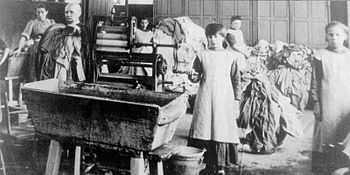
The laundries run by the Sisters of Mercy or the Good Shepherd sisters were little better than jails, in which the period of incarceration was entirely outside the boundaries of the legal system. The women who worked there were slaves.

To gain a true picture of what drove Margaret to steal her mother's savings to escape, a desperate act indeed, read The Leaven of the Pharisees.

You'll gain a different perspective on the character, an insight you might otherwise miss if you're relying on the passing reference made by the dramatists who penned the incident.

And you'll find yourself looking at her interactions with clerics through a different, more informed lens.

Saturday, November 05, 2011

Poetry Slam Gets Slammed

Literary agents love writers who teach creative writing. Look at the author biography on any piece of fiction and you're likely to find a writer who is a professor at some university, teaching others how to write just as well so they, too, can get published.

It's the teaching bit that gets a bit convoluted at times, when the professors exit their ivory towers and venture into the real world.

Denise Duhamel of Florida International University went up to the Bronx to teach a class about poetry to a group of second level students.

That was likely her first mistake, in thinking that teens filled with raging hormones and immature brain wiring would be able to handle a lesson that is suitable for twenty-one-year old MFA candidates.

Along with a colleague, she read words from index cards, and showed the students how a poem might be created. Just words. So harmless. So charming. So charged with meaning.

The teaching team used anti-black and anti-gay words, perhaps to make a point about the power of words. Instead, they gave the students permission to be derogatory and insulting, and the wee little ones took off running through the world of poetry. They, too, took up the cards and created their poems that hurled thunderbolts at the diverse student body for a full thirty minutes.

David Schiller, headmaster, has been using every word at his disposal to apologize for the ensuing debacle. The students are trying to deal with their own involvement, especially those who went along with the mob and read out words that made them uncomfortable, words they knew were insulting to their peers.

Instead of a poetry slam, Ms. Duhamel unleashed a stream of profanity and hate speech, and she truly had no idea it was coming.

Such a bruising introduction to the real world, beyond the lush confines of a Florida college campus. Perhaps it's best to keep them confined in their ivory tower where they can't get into so much mischief.

Friday, November 04, 2011

Downton And Out

Whoops. Spoiler Alert!

If you're a fan of Downton Abbey, you've been sitting on the edge of your seat, wondering who has died in the great influenza epidemic.

You may have been quite pleased to learn that ITV will be broadcasting a third season of the popular drama. How else would you know who actress Maggie Smith as the Dowager Countess is mourning as the final scene ends?

Due to a slight blunder by ITV yesterday, those who stay on top of such events already know who's not coming back.

By releasing the cast list for the third season, ITV telegraphed the third season's opener in a press release.

Newspapers are not printing the list in the hope that they won't exacerbate the spoilage for those who didn't hear the news. For those of us who don't follow all Downton Abbey events closely, we missed the reveal and we're just as much in the dark about who's gone as we will be after the final episode of season 2 airs on Sunday night.

Keep your ears open. Someone read something, and it will be the talk of the queues and fodder for chatter in offices across the U.K.

Or you can avoid all such talk and just sit on the edge of your seat until Season 3 hits the air. No spoiler in that.

Thursday, November 03, 2011

Not Satisfied To Own The Book Market, Amazon Takes On The Library

With finances stretched beyond their natural limits, more and more readers are turning to the public library for free entertainment.

Not entirely free, of course. Taxes collected from those same people cover the cost of running the library, but there's no added costs involved when you borrow a book and return it on time.

Along those same lines, if you've already signed up for the Amazon Prime program, in essence, you've paid your taxes that cover the cost of borrowing a book from...Amazon.

Yes, that Amazon. The online vendor that has driven many a small brick and mortar to the wall.

Those who pay extra for quicker shipping on their orders can now borrow a book from Amazon and download it to their Kindle.

Only the Kindle, or the new Kindle Fire tablet device. The borrowing program will not work on any other device with a Kindle app. The borrower can keep the book as long as desired, and the book then disappears when another book is borrowed.

That's one book at a time, unlike the public library where you can help yourself.

Libraries aren't overly concerned. Not all their patrons can afford a Kindle, and not many would then cough up another $79 to cover the cost of the Prime program. Besides, libraries have begun lending e-books and the selection is much better than Amazon's offering.

It should come as no surprise that the major publishing houses are NOT participating.

They're in the business of selling books, not letting Amazon pay them a flat fee for use of a copy which gets loaned out to thousands of potential buyers. With Amazon reaping the profits.

The lending idea is too new to know if it will work. Amazon has found many niches where others thought none existed, but how large is the market of voracious readers who could read enough to make the $79 fee cost effective?

And when you can go online to your public library's website and download a book from a bestseller list, why would you bother with Amazon?

Wednesday, November 02, 2011

Not The Usual Book Tour

To generate buzz for a new book release, publishers have been known to send the author out on tour, to meet and greet the readers while signing paid copies of print editions.

So how does Houghton Mifflin Harcourt promote a new edition when there is no single author?

The publisher is set to release the latest edition of their American Heritage dictionary, and it doesn't come cheap. At $60, it's more like a long-term investment. But does anyone really need a physical dictionary these days?

You sit down to write an essay and you've got a dictionary within Word. If you set up the program the right way, you'll have your spelling checked as you go along.

HMH is using marketing to get around the way things are getting done. They are going to convince the reading public that they need a dictionary, and they'll do all that with a virtual book tour without a living author.

You can follow the dictionary on Twitter, just like you might follow an author. It will share new words with you. Look, you can expand your vocabulary! You don't need Bill O'Reilly's word of the day after all.

There is a website filled with interactive activities that make words so much more interesting than you might ever have imagined. A word cloud! Let's try it!

The bottom line on the campaign is aimed at households with children. Those who are learning how to read are also building a vocabulary of new words. "Look it up in the dictionary" is an oft-heard phrase when the kiddies run across a word they've never heard before. Armed with a good dictionary, they'll learn the many meanings and even a bit of the nuance that goes along with communication.

For Mom and Dad or their high school-aged offspring, there is an online edition that they can access for free if they've bought the $60 version, or anyone can buy access for around $25. It's the reality of the marketplace these days. Print and digital are both in demand.

We still need dictionaries full of words both common and obscure. It's expensive to compile and verify all those words. HMH is turning to some heavy-duty marketing to get that point across so that they can recoup their investment in the new edition of the American Heritage dictionary.

Notice how it's coming out just in time for holiday gift giving?

Tuesday, November 01, 2011

Let It Snow, Let It Snow, Let It Snow

A day off from work is always welcome.

You can't control the weather, all you East Coast residents, can you?

So let it snow.

If you have a Kindle, a Nook, a computer or a smart phone, you can spend those leisurely days with the e-book edition of A Terrible Beauty and The Leaven of the Pharisees.

Leave the wintery weather behind and travel in your imagination to an Ireland that was buried under the dust of denial and shame, of heroes forgotten and bravery lost to time.

Books are the ultimate escape from reality, and the a novel can make for a very affordable vacation. So download a copy and get lost in some well-written historical fiction that is far from the snow and downed trees that you can't do anything about anyway.

Monday, October 31, 2011

The Long Slog Through "The Bird Sisters"

Reading for pleasure is a luxury I have no time for.

If I read a book, it has to serve a purpose. That purpose is one of research.

Who represents? That's the question that matters. Who represents the author who has a book sitting on the shelf at the public library? It doesn't matter what the book is about. All that matters is whether or not there's an acknowledgment page with a literary agent listed.

For that reason alone, I picked up "The Bird Sisters" by Rebecca Rasmussen.

I skimmed through "The Bird Sisters" to get a sense of the plot, and realized that my novel is similarly constructed. Both novels take family stories as the inspiration and then flesh out those bones with an overarching theme of personal sacrifice and redemption.

Surely Michelle Brower would be attracted to something that she's picked up already. Not that my novel is identical, but it's in the same vein.

Can you hear the silence?

That was the response to my query.

Has "The Bird Sisters" been a flop? Was it not the right book to reference in the query?

I must admit, I didn't care for it and wouldn't have kept reading after the first fifty pages if it wasn't for the research I was conducting. Neither have I recommended it to friends, who wouldn't be interested in something that tends to drag along on the uphill climb towards resolution.

The library is full of books, and I'm keeping a list of debut fiction (sparse list there) which I'll nab once the new releases are available for borrowing. As for the manuscript, I've found a publisher on my own.

But I'll keep on writing, and keep on researching who represents whom for future reference. Some fine day, I'd like to be published by a company that has a long reach into the book vending business, a reach powered by financial backing that the small indie publishers can't match.

Saturday, October 29, 2011

Seismic Shift

Long ago and far away, a king wished to divorce his queen so that he could marry a younger woman and father a son. He had a daughter already, but a girl wouldn't do. The people needed a man to lead them, a man to be the head of their army and sitting on the throne.

Divorce wasn't allowed, and the Pope said no way, Hal, you're tied to Kate and no man can put those bonds asunder. So England's Henry VIII quit the church, set up his own faith, got his divorce, and the rest is history.

In spite of the king's declaration, however, there were those who clung to their Catholic faith, and they were persecuted mercilessly for it. Yet no matter how many Catholics were assassinated, there were those too stubborn to give it up.

In the pages of A Terrible Beauty, you'll find glimpses of the vicious retaliation faced by Ireland's Catholic population. The onslaught against Catholicism led to rebellion, repeatedly, and Katie Hanrahan's novel lays out the threats to Queen Victoria's life that led to the lifting of some of the more petty penalties inflicted on Ireland's Catholic population.

The threat of a Catholic coming to power in England was too great a threat to the Anglicans in power, so it was decreed that a Catholic couldn't become king, or marry one, or even get close to any position that would upset the carefully contrived dominance of the Church of England.

Over four hundred years after Henry launched his church, the much reduced United Kingdom has put aside the rules that forbid Catholics from ascending to the throne.

It seems like a seismic shift, but in reality, it's a reflection of modern times.

Few people go to church at all anymore. Religion isn't any sort of issue at all. In short, no one cares. The British monarchy is a charming anachronism, a tourist attraction. So a firstborn girl can become queen while her second born brother has to find other employment. She can marry a Catholic and it won't influence the rights of succession.

A Catholic could sit on the throne once again. That would send Henry VIII spinning in his grave.

Friday, October 28, 2011

America, Meet Ireland's Next President

Don't confuse the titles of office.

The President of Ireland doesn't have the power that the President of the U.S. has. The Irish version is more symbolic than that, responsible for putting a public face on Ireland when visiting dignitaries come calling.

 It was the outgoing President of Ireland, Mary McAleese, who hosted the Queen of England recently when herself visited the former British colony for the first time since the micks threw off those English shackles back in 1916.

Early election results point towards Michael D. Higgins as the next President of Ireland. Who is Michael D. Higgins? The Saw Doctors explain him best. 

Thursday, October 27, 2011

The Two Dollar Offer

If I had money to spare, I'd buy shares in Exelon.

The Illinois legislature just granted them permission to raise electric utility rates, supposedly to cover the cost of upgrading to a "smart grid", but it was the shareholders who pushed hard for the right to bypass the Illinois Commerce Commission and its regulatory powers.

Only about $2 more per month, they say, for electricity. Sounds like such a small amount.

And for another $2 per week, if the Chicago Tribune goes along with their latest money-making scheme, I can have an expanded book review section along with my regular delivery.

$2 seems to be the acceptable quantity of choice these days.

For the price of a cup of coffee, subscribers would receive what looks like a magazine. Apparently, those who run the newspaper believe that book reviews, a piece of fiction, lists of bestsellers, and a roster of author appearances is something that people will pay for.

Not enough people are paying for the newspaper, unfortunately. Cost-cutting moves that slashed news reporting and the number of pages printed daily didn't help matters either.

Now the Chicago Tribune is trying to add what was removed, but tack on an additional cost. So instead of paying $390 for a year's worth of news, I would have to pay nearly $500.

The problem is, I'll be paying more for my electricity, and it doesn't take a smart grid to tell me that $2 a month isn't the bottom line figure.

As much as I love books, I won't be taking advantage of the Trib's offer. For a lot less than $2 per week, I can read their book review section at the public library.

Wednesday, October 26, 2011

The Trickle Down Has Trickled Away

Anyone fond of books is aware of the steady drip of book shop closures.

You might chalk it up to the decline in the quality of books being published today, with a heavy emphasis on that which will be a blockbuster over that which is a good read.

You can't deny that the troubles being visited on book vendors has a great deal to do with the economy and the overall lack of spare change in the average reader's pocket.

Bookstore owners have to look at any and all cost-cutting measures to survive, and once they've exhausted all options, they'll turn to the property owner and beg a reduction in the monthly rent. After all, space that was once worth a given amount during the boom times isn't worth that much any longer.

For New York's Cooper Union, however, there isn't enough money trickling down from above to trickle down to the owners of St. Mark's Bookshop who came calling with hat in hand.

Bob Contant and Terry McCoy can't keep their doors open and still pay the same rent they've been paying back when the bookstore was flush. The problem is, property owner Cooper Union is equally skint.

For Cooper Union, there is the option of renting the space to someone else who would be willing to pay the price that's been set. The iconic school would then maintain that level of much needed income, and there'd be no need to ask teachers or staff to take a pay cut to make up the difference.

So is there someone else waiting in the wings to take over the space? Given the state of things, it doesn't seem likely.

Being a popular place, St. Mark's Bookshop has turned to its customer base for help, but petitions don't put money in the till. While there's been a slight uptick in sales as people make purchases to help out, such an uptick won't last forever and there's no light at the end of the economic tunnel coming into view just yet.

Somehow, Mr. McCoy and Mr. Contant have to convince the powers that be at Cooper Union that a reduced rent is better than no rent at all, and that's what is most likely to happen if the bookshop has to shut its doors.

Is there no one out there who patronizes St. Mark's Bookshop who can lean on friends or colleagues with some influence at Cooper Union? Some architects or engineers who benefited from the school, and who like to read?

Tuesday, October 25, 2011

The Fine Art Of Editing

At Newcastlewest Books, we're getting ready to release our second offering of well-crafted historical fiction. That means editing the manuscript.

As an author, you're probably too close to the novel that you slaved over for months if not years. With the words so deeply imbedded in your brain, it can be difficult to stand back far enough to spot the small flaws that make readers put your book down.

Hence, the need for a third party to come in and read, and search out the problems that spoil the fun for your potential audience.

It's easy enough to write your story, but you may not realize that you've lost the tension somewhere in the middle. An editor can help you spot such things, and point out areas where you need to rewrite a segment. It could be something as minor as adding an additional sentence. It might require a revision of an entire chapter. It could mean cutting out two or three chapters altogether.

So I'll be working on edits today, reviewing the changes that our author has made. We want our readers to keep on turning the page until they get to the end. Such an accomplishment requires effort on our part, but what's the point of publishing something if it isn't done well?

Not something that can be done quickly, but it must be done if the book is to succeed when it's released for the holiday book-buying season.

Monday, October 24, 2011

But Don't Consider The Past Record

From the same gang of geniuses who gave us the clerical abuse crisis comes the latest plan to fix the world's troubles.

Right, they haven't cleaned up their own house but that doesn't stop the Vatican from chiming in on how to solve the world's economic problems.

The Vatican's department of Justice and Peace has called for a world authority to run everyone's finances. Just like the Catholic Church has one Pope in charge, so too would all the banks and financial institutions be beholden to one central planning committee that would levy taxes on transactions and use the income to make the world a better place.

We all know how well that centralized system has worked for the Holy See.

As you'd expect from the Vatican, the plan berates neo-liberalism and markets and all the other bogeymen that have been called out as the cause of Catholics fleeing from the Church. If you've sat through a few sermons in your lifetime, you'll recognize the oft-repeated litany that accuses us all of greed and hoarding wealth, causing so much unhappiness. Buy more black babies. Donate to the missions until it hurts. Help propagate the faith with your coin.

The poor you have always with you, and whensoever you will, you may do them good.

No, don't pay attention to that bit. Jesus gets in the way sometimes, doesn't he.

And everyone would start going to church of a Sunday and putting some money in the collection basket. The settlements from all the lawsuits brought by abused children is going to bankrupt the Church if the financial picture doesn't improve.

Somehow, it's laughable that the Holy See would develop a global economic plan when it has a long string of failures in its record. Back when the faithful didn't pay much heed to the Pope, he declared that he was infallible and that was the end of dissension.

Wouldn't the world be a better place if the United Nations was running the world's financial markets and they could just speak Ex Cathedra?

Saturday, October 22, 2011

Libraries As Luxury

After the British learned of the fire that burned Chicago to the ground, they sent something that was believed to be essential to civilization.

They sent books. Enough to fill a public library.

Over time, the Chicago Public Library grew as the city grew, with branches added to neighborhoods so that people could have access to books.

These days, it isn't so much the books that people want, but the computers and the shelter and the free after-school care.

Given the high cost of operating so many facilities, it's become impossible to keep them all open and fully staffed. Mayor Rahm Emanuel, a product of the toney suburb of Wilmette, has proposed cuts to the library budget as a way to tackle the city's severe fiscal headaches.

No one wants to see fewer police on the streets, or fewer garbage trucks or fewer pothole repair crews. So what can be bent yet not broken? The library.

A library can function with one librarian instead of three. Not well, but people will have to learn to wait their turn when they have a question or need help locating a book or logging onto a job search on the computer terminal.

Readers can learn to wait for the library to open, so if it means getting in at noon instead of nine a.m. on a Monday morning, they'll have to to deal with the inconvenience.

Sadly, there are fewer and fewer patrons to be inconvenienced. Library usage has been declining year after year. Reading a book for free is no longer seen as the escape that it once was. There's mindless television for that.

The school system in Chicago is failing to crank out educated people. At the rate they're going, there won't be much need for most of the branch libraries at all. After all, if people don't know how to read, they don't have much interest in going to a building that's built expressly to house and distribute reading materials.

That's when the city can realize some real cost savings, but at an expense that can't be calculated on an Excel spreadsheet.

Friday, October 21, 2011

Actions That Speak

An ongoing battle between religious conservatives and those who think all scientific research is essential has been quietly smoldering.

It will fire up again as the election cycle reaches its peak.

Before the 2012 elections, however, the Vatican is going to take some actions that speak louder than a chorus of bishops singing about the evils of embryonic stem cell creation.

The Vatican is going all out to support research into adult stem cells. It's a case of action that backs up a lot of words.

Look how productive we can be, says the Holy See.

According to Robin Smith, owner of NeoStem, the Vatican will get behind her work on adult stem cells.

By sponsoring conferences on adult stem cell research, assisting with fundraising, and the like, the Catholic Church will actively support a medical field that has put it at odds with many of its members. And it makes sense.

To decry an area of scientific endeavor that could lead to eradication of several serious medical conditions is to sound quite anti-science. On the other hand, stand up for part of that same field and the Church can put its money where its mouth is.

Thus far, it is adult stem cells that have shown the most promise, with embryonic stem cells little more than a scientist's hypothetical dream. By promoting adult stem cell research, the Church can push development and leave the whole concept of fetal stem cell collection in the dust.

It's one way to end the controversy. Developments in the adult stem cell area can lead to more study as scientists build on each other's findings. Meanwhile, fetal stem cell research remains in its infancy (rim shot!) and fades into obscurity.

More than mere decrees from on high, the Church's position on adult stem cell research demonstrates that it isn't anti-science. If anything, it shows that important research can be conducted within the Catholic ethos.

For such a hide-bound institution, it's remarkably forward thinking.

Thursday, October 20, 2011

A Smarter Class Of Catholics

In the middle of the economic crisis, those who keep tabs on the minutiae of life have noted that college-educated workers are less likely to be out of work than their working-class counterparts.

That being the case, it's no surprise that Jim Allister is concerned at the overabundance of Catholics...yes, Papist, popish, Rome-rule Catholics...are taking over Ulster's universities.

As if that wasn't bad enough, there are foreigners taking up spaces that could be used by God-fearing Protestants. Foreigners from...gasp...the Republic of Ireland!

They gave up their guns and they've gone on the attack on another front, a sneak attack that will have devastating implications for the future. "I will be writing the Vice Chancellor" of the University of Ulster, says Mr. Allister. Something must be done to recruit Protestants and defeat the Catholics at their own game.

The Catholics will get all the benefits of a third-level education, and then they'll reap those benefits at the expense of an uneducated Protestant population. Benefits will include such things as important positions in the law and medicine, in politics and executive suites where policy is made.

It's a very slippery slope, with the Protestant overlords sliding to the bottom of the heap. The next step is nearly unthinkable: the unification of Ireland.

Don't think it can't happen. Isn't Martin McGuinness, a Shinner from Northern Ireland, running for the Irish presidency? What do you think he's got on his mind besides the reunion of all thirty-two counties?

Too many Catholics in Ulster's university system is a danger to be addressed, and Mr. Allister is going to attack that problem with every fiber of his Protestant being. After fighting against Catholicism for centuries, he isn't going to sit back and let the Catholics win back their country.

Tuesday, October 18, 2011

Authors Are Still Writing

The publishing industry is suffering, along with just about every other industry.

It's refreshing to hear a little note of hope from the Great Lakes Independent Booksellers Association. "Authors are still creating books," said Tom Lowry of Lowry's Books. The book business is still very much alive, even if it isn't kicking with as much force as it once did.

Independent booksellers fell victim to the big box stores and the purchasing power of Amazon. There are fewer of them than there were ten years ago. Not exactly a bright scenario for those still standing.

At their recent conference, the association had to face tough choices to survive. The group's annual trade show will be a combined affair in the future; the need to cut costs means the Great Lakes group will join the Midwest Independent Booksellers in 2012.

GLIBA has made staff cuts as well, to ease the pressure on the bottom line when the organization has fewer members paying dues to keep the doors open.

Dire circumstances, yes, but those who love books can take heart in the knowledge that authors are still writing and publishers are still publishing.

It will be up to the indie vendor to develop a strategy to stand out from the pack, and often that involves outstanding customer service, product tie-ins, readings, and whatever else a shop owner can think of that the big boxes or the online store can't do.

The road is rocky and will continue to be rough in the foreseeable future. But there is a future out there, in a place where authors are still writing and publishers keep putting out books to be read.

Monday, October 17, 2011

Who Needs Gaga When You've Got Bono

The stars were shining brightly in the Hollywood Bowl this past weekend, and a couple of Irish fellas outshone the flashy Lady Gaga.

Celebrities gathered to celebrate the 65th birthday of the 43rd President, and to commemorate the 10th anniversary of the founding of Bill Clinton's foundation.

Bono wouldn't miss such an occasion.

He's all about fighting poverty in Third World countries, coming as he does from a nation that taught its children to buy as many African babies as possible. Helping those same people is almost part of the man's Irish DNA.

All the good deeds are grand, but the Hollywood elites who donate to such foundations need entertainment to loosen their grip on their cash. The concert at the Hollywood Bowl did not disappoint.

Usher worked the stage with such vigor that he split a seam in his trousers. Lady Gaga did a fine impersonation of the late Marilyn Monroe and sang Happy Birthday to the man of the hour. Mr. Clinton failed to deliver on her heartfelt wish, that he play the sax with her. Sadly, the former President did not come prepared to perform.

But it was at the end of the concert that the crowd got what they'd come for. Bono and the Edge performed an acoustic version of "Sunday, Bloody Sunday", in tribute to Mr. Clinton's efforts all those years ago to bring peace to a divided Ireland.

The close of the concert was the high point of the evening, and what can you expect?

After all, a song like "Born This Way" just doesn't have the impact of a tune that memorializes the massacre of innocent protesters at the hands of the British military, even if the incident is three decades in the past.

Saturday, October 15, 2011

Call Judge Judy

The Presidential race has become a festival of mud-slinging that is carried on RTE for any who care to listen.

Sexual abuse, cover-up and scandal in the quest to make Aras an Uachtarain her home? In the case of Dana Rosemary Scallon, it's time to call on Judge Judy.

It's a family spat at the heart of the latest accusation launched at Presidential candidate Dana. And it's far more than the earlier dust-up over Ms. Scallon's possession of American citizenship and whether or not that disqualifies her from becoming Ireland's President.

This is the stuff that makes up the juiciest bits of Judge Judith Sheindlin's daily television program. Dana and her sister and her brother and her brother-in-law are all in the center of a sexual abuse allegation that's tangled up in the middle of a business spat over Heart Beat LLC.

Ms. Scallon's brother-in-law claims that his daughter was sexually abused by Ms. Scallon's brother, which then led to the legal dispute over the business they were all in jointly. Ms. Scallon says it's all a lie, and if the brother was indeed abusing the niece, why was there never a complaint lodged with the local police department?

The fact that the brother-in-law hired a team of personal injury lawyers to represent his side of the story back in 2008 had my American friends snorting in derision. Ambulance chasers, they said. The carrion crows of the legal profession. Such is the reputation of personal injury lawyers that they would think twice before believing anything such a legal advocate claimed to be true.

Then there's the lack of prosecution for a serious crime. You can almost hear Judge Judy now, tearing into the family who failed to seek justice for their daughter, and comes forward years later to use the accusation as leverage in a squabble over copyright issues.

Involved in a family dispute? The Scallon sisters clearly are. And while they may have agreed to disagree, to never speak again, the dirt's come out from under the rug. Such is the nature of hotly contested political races.

Yet what does Ms. Scallon's brother's purported behavior have to do with Ms. Scallon's ability to represent Ireland to the world?

Nothing at all.

But it makes for good copy. And good television. Call Judy now.

Friday, October 14, 2011

Google This

While you're out there occupying Dame Street or Wall Street or whatever street you've chosen, google this.

What is a Dutch sandwich with a side of double Irish?

And which major corporation might be making best use of it?

Got your iPhone out? Ready, steady, go.

It's a trick question. The answer is Google.

The Internal Revenue Service is taking a long, hard look at Google's remarkable ability to dodge its "fair share" of corporate taxes by availing itself of the the double Irish.

At question is the legality of a move that was made legal in 2003. As far as the U.S. government is concerned, that deal applied to Google's intellectual property at the time. Any and all things added since then can't be shifted around in a tax dodging shell game. Google googled the issue and the computer says no.

Google Ireland pays licensing fees to Google Ireland Holdings, a subsidiary that is licensed by Google. GIH says its management is in Bermuda, which doesn't tax corporations. Google Ireland Holdings is paid from Google Ireland via a Dutch holding company, thus avoiding the Irish withholding tax. Once Google Ireland deducts its administrative expenses, there's nothing left to be taxed by the Irish Exchequer. Google avoids paying U.S. taxes because the profits are made in Ireland.

Google has pocketed as much as one billion dollars...per year...by avoiding the U.S. corporate tax rate of 35%. They'd like to keep things as they are, naturally, and include their recent acquisition of YouTube under the tax dodging umbrella.

You'll hear politicians speak of a tax holiday, in which corporations like Google can repatriate all those profits they've shuffled around the globe without having to pay that 35%. Something is better than nothing, goes the logic.

Not that Google is the only firm to take advantage of a convoluted tax code that is riddled with loopholes. All the large multinationals are just trying to save a buck and improve their bottom lines. It's a question of what is cheaper, paying or avoiding.

Lower the tax rate to be in line with other countries, and when it's not cost-effective to move money around, the Dutch sandwich will be left on the plate.

Still think it's the big bankers and millionaires and billionaires not paying their "fair share"? The computer says no.

Thursday, October 13, 2011

Don't Call It Chinatown

You want Chinese food in Chicago or New York City or Los Angeles and the first place you think of is Chinatown.

Every major city seems to have an ethnic neighborhood where Chinese immigrants put down roots in American soil. Those neighborhoods retain the Oriental flavor and for many, it's almost like taking a vacation to another land just by going out for dinner.

If you read between the lines and listen with your politically correct ears, you'd guess that the Dublin Civic Trust would like to incorporate a little Chinatown along Parnell Street East.

They're calling it an "oriental enclave", what they'd like to see develop in an area filled with historically significant Georgian buildings that are currently rotting away.

The Dublin Trust would like to see the buildings maintained and restored to their original facades, but the types of low-rent businesses that occupy the storefronts aren't conducive to architectural rehabilitation. There's simply not enough money coming in to spend lavishly on a pretty face.

Why look to Chinatown "oriental enclave"?

That's pretty much what the area is. Asian businesses are keeping the street alive, although not keeping it attractive.

While the Trust would like the Dublin City Council to do its job in policing property usage, it wouldn't mind if the council put some thought into the area's master plan and organized all the Asian bits into one particular area, where Oriental architecture could be utilized to craft a more ethnic-looking enclave.

The significant buildings could be restored to what they once were, without the ethnic-looking signage and illegal uses.

Dubliners and tourists looking for a decent General Tso's chicken would have a place to go, with scenery and facades familiar to residents of other big cities with their own Chinatowns. Anything that brings in foot traffic would improve the area, which would make an investment in a Georgian building (and its subsequent restoration) less of a risk.

Simple enough in concept and not all that difficult to enact.

Just don't be calling it "Chinatown".

Wednesday, October 12, 2011

Playing To Type

Or, once a bully, always a bully....

British actor Jamie Waylett is best known for his portrayal of Vincent Crabbe, member of the Draco Malfoy posse in six of the seven Harry Potter films.

He did some of his growing up on a sound stage, busy working at a young age. He portrayed a bully. It seems to have stuck.

Mr. Waylett's very recognizable face turned up on something other than a large screen recently. London police were perusing hours of CCTV footage following the destructive riots last August, and weren't they surprised to see the lad in an unscripted scene.

The former Hogwarts student happened to have a Molotov cocktail in his hand, in the center of a mob.

Petrol bombs being illegal, the actor was arrested. And to add to his difficulties, the police then found a little forest of cannabis plants at the flat he shared with his mother and siblings.

Again, Mr. Waylett was found to be in possession of illegal substances and the charges were elevated. It seems quite insignificant that he was also charged with possession of stolen goods because he was involved in looting a bottle of champagne from Sainsbury's.

Will Jamie Waylett's outstanding portrayal of a bad person work against him when he appears before a magistrate next month? You'd hope the judicial system could look beyond typecasting and deal with the actor in an unbiased way.

Perhaps some psychologists could be called in to testify, to explain Mr. Waylett's behavior as that of a young man who has already reached a peak in his profession and is now lost, like so many other child actors before him.

Surely he made enough money from his work on the Harry Potter series to cover the expense of a stinging fine.

Will J.K. Rowling feel compelled to reach out to someone who put a face to one of her imaginary characters, in an attempt to not have that face associated with crime?

Tuesday, October 11, 2011

E-Book Reckoning Is At Hand

The publishing industry is in turmoil because no one knows exactly how to handle e-books and digital rights.

Literary agents attending the Publishers Launch conference in Frankfort, Germany, have let it be known that publishers had best get their act together, for the day of reckoning is at hand.

They're at risk of becoming dinosaurs, those traditional publishers, because they don't know which way the digital world will evolve and they're too slow to move. For that reason, some literary agents have taken over the task of publishing their clients' e-books.

The industry waits for no one. Standing still won't get it done these days.

Like so many other problems, the issue is one of money.

Agents have a vested interest in getting the highest rate of return for their authors, since the agents' commission is larger when the author's royalties are greater.

Traditional publishers want to keep slogging along in their accustomed rut, but everyone knows that e-books are cheaper to produce and distribute. The authors want a bigger piece than has been offered in the past, knowing that the publisher is getting a much bigger piece and who did the actual work to create the book in the first place?

There are those in the old-fashioned print world who see the digital book as a threat and so they shun it. Authors and literary agents see the digital book as a cheap alternative to the hard copy, just as the paperback was the alternative to hardbound books. More people could afford to read when the cost of the book went down, and more books were sold.

Computers are everywhere. Smart phones abound. All have applications for downloading e-books, which means e-books could be distributed everywhere and maybe, just maybe, more people would be tempted to read a book when it's a relatively cheap entertainment.

Until publishers accept such a potential, the literary agents will keep looking out for their authors and handle the e-book rights in a way that yields a maximum payout.

Publishing is changing. If publishers don't take a hard look at their business model and find a way to reimburse authors at mutually acceptable rates, they may lose out to an author whose agent assists in the creation and publication of an e-book where all sales income goes back to the author.

Sooner, rather than later, the publishing houses will have to understand that something would be better than nothing, especially when a printing press and book bindery aren't needed in a paper-free world.

Monday, October 10, 2011

Miss Iceland That's Cold

On the run for years, mobster Whitey Bulger was done in by Miss Iceland.

A beauty queen turned in the beast.

The arrest of Mr. Bulger has nothing whatsoever to do with beauty or queens or the prettiest woman in Iceland in 1974, but it does make for an attention-grabbing headline.

In reality, it's sheer coincidence.

Anna Bjornsdottir just happened to live near Whitey and his moll. She saw the advertisements that the FBI had placed where women were most likely to see them, in the middle of daytime television programmes.

It didn't take a particularly keen eye to recognize her neighbor whom she'd befriended some years back. Without thinking about her own safety, or the ability of Mr. Bulger to call in former members of his gang to avenge him, she made the phone call.

Today, she's $2 million ahead of the game, the recipient of the award for those who came forward with credible evidence.

Mr. Bulger and his sidekick are in jail, awaiting trial, and there's been not a sound heard from those who once took orders from the purported murderer. After almost two decades on the run, the gang appears to be gone and Mr. Bulger is very much alone.

The former Miss Iceland can live rather well in California on $2 million, well invested to last the rest of her days. She won't have to try to cash in on her sudden fame, but will someone accustomed to the bright lights of the pageant world be able to resist the siren song of the national news programmes when they call asking for an interview?

Saturday, October 08, 2011

The Vow Of Poverty Only Goes So Far

Maybe it's somewhat like the vow of celibacy that priests are expected to make. Eamonn Casey wasn't one to take it literally, and Michael Cleary made a mockery of it.

It shouldn't come as much of a surprise when the whole "vow of poverty: business is equally inconvenient and must be ignored.

Papal Nuncio Giuseppe Leanza is leaving Ireland to take a post in Eastern Europe. Enda Kenny is happy enough to see the cleric's back, considering the fall-out from the Vatican's slap at An Taoiseach after Mr. Kenny pummeled the Holy See for its callous disregard of Irish law in regard to the clerical abuse scandal.

The Vatican's solution to problem clerics has long been the shuffle, and sending Father Leanza to a new post feels like more of the same. The pedophile priests were moved around from parish to parish, sometimes sent from Ireland to America and back again. There must be airline miles saved up that need to be used before they expire.

Farewell, Papal Nuncio, bon voyage and good luck. The Irish bishops have been told that the voyage would be far more bon if they'd all give Father Leanza a little parting gift of 500 euro.

A vow of poverty? Is there really such a thing when we're talking about the so-called "Princes" of the Catholic Church?

Do the math. Twenty-eight bishops times 500 euro equals a great deal of money, and the gift is asked at a time when the forgotten Maggies are seeking some kind of compensation for their years of slave labor that benefitted the Church.

Pick up and read a copy of The Leaven of the Pharisees and you'll understand why the request is more than outrageous.

To date, there's not a dime to be found for the women who toiled without pay in the laundries run by the religious orders. But the bishops are supposed to come up with 14,000 euro as a gift to a Catholic priest who is supposed to shun earthly rewards.

What does he need it for? To donate to his favorite charity?

The Justice for Magdalenes organization could put 14,000 euro to good use. Just a little suggestion, to help mend those fences that were broken to pieces after the Cloyne report was made public.

Friday, October 07, 2011

Qualifications For A President

We're all aware that the U.S. President has to have been born there and be a citizen of the land.

In Ireland, it's difficult to enforce an equal restriction.

There's Dev, you see.

Parentage uncertain, history never fully explained, but without a doubt the old man was a Yank and didn't he rise up to the top of Irish politics?

So how could it be a problem for former singer and politician Dana (more properly, Dana Rosemary Scanlon) to become President of Ireland?

The issue came up before, when Dana wanted to run for the presidency and she had only just sworn to uphold the Constitution of the United States of America.

Or maybe it didn't.

Back in 2008, when Ms. Scanlon took the oath of allegiance to the Stars and Stripes, she and her sister were engaged in a battle over rights to some of Ms. Scanlon's recordings. Words flew in the courtroom, and those words are popping up again now that Ms. Scanlon is in the running.

During bitter testimony, Ms. Scanlon's sister claimed that there was a long discussion about the problem of Dana running for the presidency in 1997, just after becoming an American citizen. Ms. Scanlon doesn't recall any such discussion, and sees no reason to hide her dual citizenship. After all, there was Eamon de Valera at the beginning, and everyone knew his American citizenship kept him from the firing squad at Kilmainham.

Ms. Scanlon sees herself as a dual citizen, her Irish loyalties intact. She says she only votes in Ireland, not America, and isn't that proof of her loyalty? Makes her American citizenship look like some kind of convenience or legal dodge, coming as it did while she was warring with her sister over those recordings.

And no, she doesn't recall the part of the oath that all new U.S. citizens take, renouncing allegiance to all other foreign lands. That includes Ireland, sad to say.

It's up to the Irish voters, in the end, but chances are, one of the many candidates will make a fuss over the dual citizenship thing in an effort to get ahead.

Pity that Ms. Scanlon can't take the de Valera analogy a step further and point to her Irish Republican Army support...no, wait, that's Martin McGuinness coming under fire for that one.

Thursday, October 06, 2011

Commemorating The Link Between Writing And Drink

An Post has just commemorated the great Irish writer Flann O'Brien by issuing a stamp with his likeness to decorate your mail.

No greater honor?

The Palace Bar has gone one better, topping the postal service.

The favored pub of writers from The Irish Times has placed the image of Mr. O'Brien into the footpath outside the front door.

Now that's permanence. That is genuine honor.

The bronze plaque is one of four that pays tribute to the likes of Brendan Behan (died of the drink), poet Patrick Kavanagh, and sports writer Con Houlihan, every one a patron of the establishment.

Writers have long been associated with alcohol, and the unveiling of the plaques serves to reinforce the belief that alcohol is often the inspiration behind some of the world's greatest literature.

Where's there alcohol, there's often a bar, the place where writers could congregate before there was an "online community." The bar was the place to come together, to share ideas, talk over stories or perhaps find a hint of a plot in need of fleshing out.

Now bar owner Willie Ahern has set four reminders out front, as much to celebrate his pub's important position in Ireland's literary history as to draw in paying customers who might wonder about those four bronze faces that they nearly stepped on.

A stamp?

After it's issued and sold through, it's gone but for the few stamp collectors still in existence.

But bronze?

Now that's something that will last, to be seen by countless drunks stumbling along the road, heads down as they watch for trip hazards.

Wednesday, October 05, 2011

Agency Merger Du Jour

Literary agents come and literary agents go and then they decide that size does matter.

What does all that mean?

Jason Allen Ashlock left a big agency to start his own firm, taking along a couple of other agents and their clients.

Thus was born the Movable Type literary agency.

Adam Chromy ran a small agency that had two other agents at his side, most of the time. You see, agents come but they also go when they abandon the business or get a better paying job elsewhere in publishing.

Businesses have fixed costs, and if you merge two companies, you can cut those costs down to size if they're too gargantuan. In addition, if staff leaves and takes clients with them, it becomes more difficult to meet costs of any type.

Thus is born Movable Type Management.

Agents Ashlock and Chromy have merged into one entity, and those who follow the literary agency roster will notice that former Movable Type-sters Meredith Dawson and Rachel Vogel are not on the team.

That's not all that's changed.

At one time, Movable Type wasn't interested in a query letter. They wanted the opening pages of the novel for their consideration, believing that the writing was important. Not all authors are marketing gurus who can pen good sales copy.

This time around, there's an online form to be filled in. You'll be needing a proper query letter in future.

So fire away with your queries. Often, a fresh start can inspire a literary agent to feel the pressure to take on and sell some new manuscripts. It could be yours. You won't know unless you give it a go.

Tuesday, October 04, 2011

At Public Expense When The Money Is Gone

Often, they are mentally ill but capable of functioning on their own. And they die alone, surrounded by neighbors who don't know them. Next of kin? Who could say?

The Cook County Morgue is responsible for handling the dead bodies of those who have no next of kin, no estate to pay for burial, or no known identity.

In the past, when there was money in the system, the morgue would store the bodies and hope that someone would notice a relative had gone missing.

At the end of a year, unclaimed remains were crated up in cheap pine boxes, loaded into a truck, and carted off to a mass grave which the Cook County taxpayers funded.

No one put a lot of effort into noting the exact location of each individual corpse, so if relatives did turn up much later, it was highly likely that their dear departed's body wouldn't be found. If the Cook County Sheriff wished to claim a body for a criminal investigation, well, good luck with that.

Like everyplace else, Cook County is out of cash and looking at ways to save money.

The unclaimed dead aren't going to complain.

From now on, bodies stored in the morgue for two weeks are going to be donated to the Anatomical Gift Association. Medical students, student nurses, and the like, will dissect the bodies and further their education.

At the end of the anatomy class, the unclaimed pieces will be cremated and buried, all on the Anatomical Gift Association's dime.

How much will this tactic save the county?

It's hard to say, because bodies that are decomposed, over three hundred pounds, or HIV-positive can't be used.

Many of the elderly who die alone are not found for days or weeks, their passing often noted by the unpleasant scent of decomposition. Drug addicts who are discovered in abandoned buildings aren't likely to be sliced and diced by future doctors either. As many as 60% of the bodies brought to the morgue are autopsied, and those are useless for anatomical study.

Oddly enough, the Sheriff's complaint about bodies buried without sufficient documentation isn't going to improve when all he might be able to recover is a small box filled with ashes.

But the County will save the taxpayers at least some of the expense of burying the dead who have no known relatives, as long as those indigent few have the decency to not be obese, and die someplace where their corpses can be quickly recovered, the cause of death obvious.

To think that the study of human anatomy once relied on grave-robbing. Now the county can't even afford the grave.

Monday, October 03, 2011

Competing For The E-Book Rights

Not sure where the future of e-books would be, several literary agents became publishers of a sort when they expanded their business model into the production and promotion of their clients' e-books.

As you might have guessed, the traditional publishers couldn't help but notice and they've started to poke their wee heads over the parapet and launched a counter-attack.

Perseus Books will now help authors self-publish their titles electronically. Take that, literary agents who dared to leave the safety of their defined tasks.

In fact, an author wishing to use the Perseus service must be represented by an agent who's already signed an agreement with Perseus. That's one way to undercut the agents who have gone off on their own. Now there's a publisher that's willing to do the heavy lifting on the e-book front, so if an agent were thinking of doing it themselves, they won't have to.

Whether it's the literary agent or Perseus doing the publishing, the idea is the same. Authors have books that the traditional publishers don't want because they're not blockbusters and the author wants the work out there so that the public can decide if it's worth a read. There's backlist offerings where the rights have reverted to the author, and why not make a book available if it's gone out of print? Someone, or several someones, might be interested, and it makes no sense to miss out on additional sales.

With a marketing department already in place, Perseus is well positioned to handle the promotion end of things, just as publishers have always done. Little wonder that Janklow & Nesbit has signed up, with Curtis Browne not far behind.

The competition between the literary agent and the publisher is forming up sides. Who knows which direction the publishing industry will take?

Saturday, October 01, 2011

A Plot For A Financial Thriller

You can't make up stuff like this, so you might as well take it and use it as the plot for that thriller you've been longing to write.

I'd do it myself, but I'm not familiar with the genre and I'd hate to spoil a good story with poor pacing or a style that would give away too much too soon.

The story is set in the recent past, during the height of the property boom. Everyone is keen on making big money on land, buildings and rents. Banks are keen to throw money at investors.

Two men cook up a little scheme to get their hands on some of that cash. If you're inclined to think Ocean's Eleven, you'd make the narrator one of the clever lads. On the other hand, you could use some wonky bank investigator as your hero and put him to the task of tracking down the bank's assets.

Achilleas Kallakis (as played by George Clooney, perhaps?) and Alexander Williams (Brad Pitt comes to mind) were able to convince authorities at Allied Irish Bank to lend them E850 million to purchase an office block in London's Euston Road.

Who is backing them, the bank asks. Why, Chinese property giant Sun Hung Kai Properties are guaranteeing the loan. A Chinese firm? The two gentlemen making the request are as Caucasian as can be. The bankers become suspicious.

Enter Jonathan Lee, suitably Asian, who brings in documents with solicitors' stamps that attest to the veracity of the guarantees.

The trio take the money, buy the property, and party hearty on the excess. They came away with a couple of million euro to fund a very lavish lifestyle.

Where it gets difficult to explain as an author is the part where the perps set up a shadow company to buy the property, and then set up another that was said to be a branch of SHKP which was renting the property. You, the author, have to make it realistic enough to be convincing or the reader won't keep turning the page.

Your bank investigator hero comes into play at this point, demanding further guarantees on the rents and loan repayment. The scammers then create yet another shadow company but the persistant examiner trips them up when they can't produce concrete evidence of the firm's assets.

Somewhere in there, you'll want to insert a Julia Roberts character who comes to find that her beloved was lifting cash to buy her love, or some such plot device that creates a touch of romance.

Not that such an element has emerged in court, where Mr. Kallakis and Mr. Williams are on trial for fraud, but a well-written novel requires more than the cold, hard facts.

It's one thing for the men in the dock to insist they believed that the forged documents were real. It's far more intriguing if one of them has a compelling reason to commit such a huge and complex crime.

Now go write that novel. Don't forget to leave room for a sequel.